

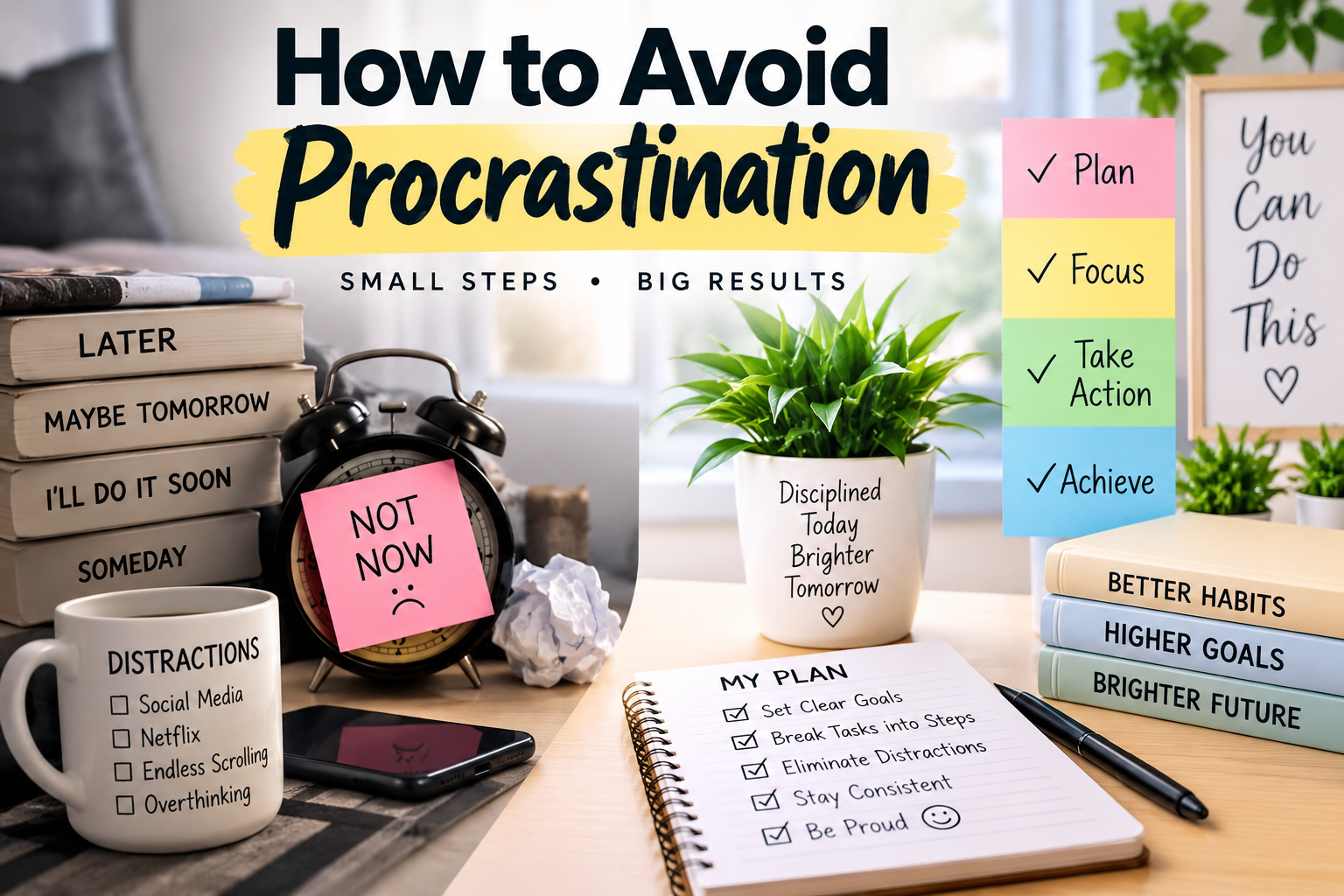
To avoid procrastination while studying, make the next task small, specific, and easy to begin. Instead of telling yourself that you need to “study for three hours,” decide exactly what you will do first—review five pages, solve ten questions, or write one paragraph—and start with a short, focused session.
The important part is not waiting until you feel motivated. When studying feels difficult, boring, or overwhelming, reducing the size of the task and removing distractions can lower the resistance that keeps you from starting. Once you are working, you can decide whether to continue for another focused session.
Procrastination is not simply a matter of laziness. Research on academic procrastination points to several contributing factors, including self-regulation, time management, task difficulty, environmental distractions, and other personal or academic circumstances. The aim is not to eliminate every moment of delay. It is to make productive action easier and repeated postponement less likely.
Why Do Students Procrastinate While Studying?
Students procrastinate for different reasons, and the cause is not always obvious. A task may feel difficult, unclear, boring, or simply too large to tackle in one sitting. At other times, the immediate appeal of checking a phone, watching a video, or browsing social media can outweigh the less immediate reward of finishing schoolwork.
Academic procrastination is closely related to self-regulation—the ability to manage your attention, behavior, and effort while working toward a goal. Knowing that you need to study does not automatically make it easy to sit down and do it.
The environment matters as well. Long deadlines, limited structure, tempting distractions, and competing activities can all make postponing academic work easier.
That is why simply telling yourself to “be more disciplined” often has limited value. A better approach is to identify what is making the task difficult to start and change that part of the situation.
Feeling Overwhelmed Makes Starting Harder
“Study chemistry” sounds simple, but it is actually a vague instruction. Which chapter? Which topics? For how long? Should you read, make notes, or answer questions?
A large or poorly defined task forces you to make several decisions before you can even begin. That uncertainty can create resistance.
Compare it with a much clearer instruction: “Read the first three pages of Chapter 4 and write down five important points.” Now the starting point and the expected result are obvious.
Breaking work into a clearly defined first action removes some of the mental friction that comes with a large assignment.
Waiting for Motivation Can Keep You Stuck
Many students assume they need to feel motivated before they can study effectively. The problem is that motivation changes from day to day and even from hour to hour.
If studying only happens when you feel enthusiastic, important work can repeatedly be pushed aside.
A more dependable approach is to make the first step small enough that it does not require a major burst of motivation. You may not feel excited about opening a textbook, but beginning with one page or a few practice questions can be manageable.
Distractions Compete for Your Attention
Phones, notifications, social media, games, messages, and unrelated browsing can pull attention away from a study session almost effortlessly.
Research involving students has found an association between mobile-phone addiction and procrastination, although an association does not by itself prove that phone use causes procrastination.
The practical lesson is straightforward: do not make willpower your only defense against distraction. If something repeatedly interrupts your attention, change the environment around it.
How to Avoid Procrastination While Studying
The most useful approach is to make studying easier to start while giving yourself enough structure to keep moving.
Start With One Small, Specific Task
Replace broad intentions with a task you can clearly identify as finished.
Instead of saying, “I need to study history,” decide, “I will read pages 30–35 and answer the five review questions.”
The difference may seem minor, but a specific task removes much of the uncertainty surrounding the first step. You know what you are doing, where to begin, and what completion looks like.
It also prevents another common problem: creating an ambitious study plan that looks impressive on paper but becomes difficult to follow in real life.
Break Large Study Tasks Into Smaller Steps
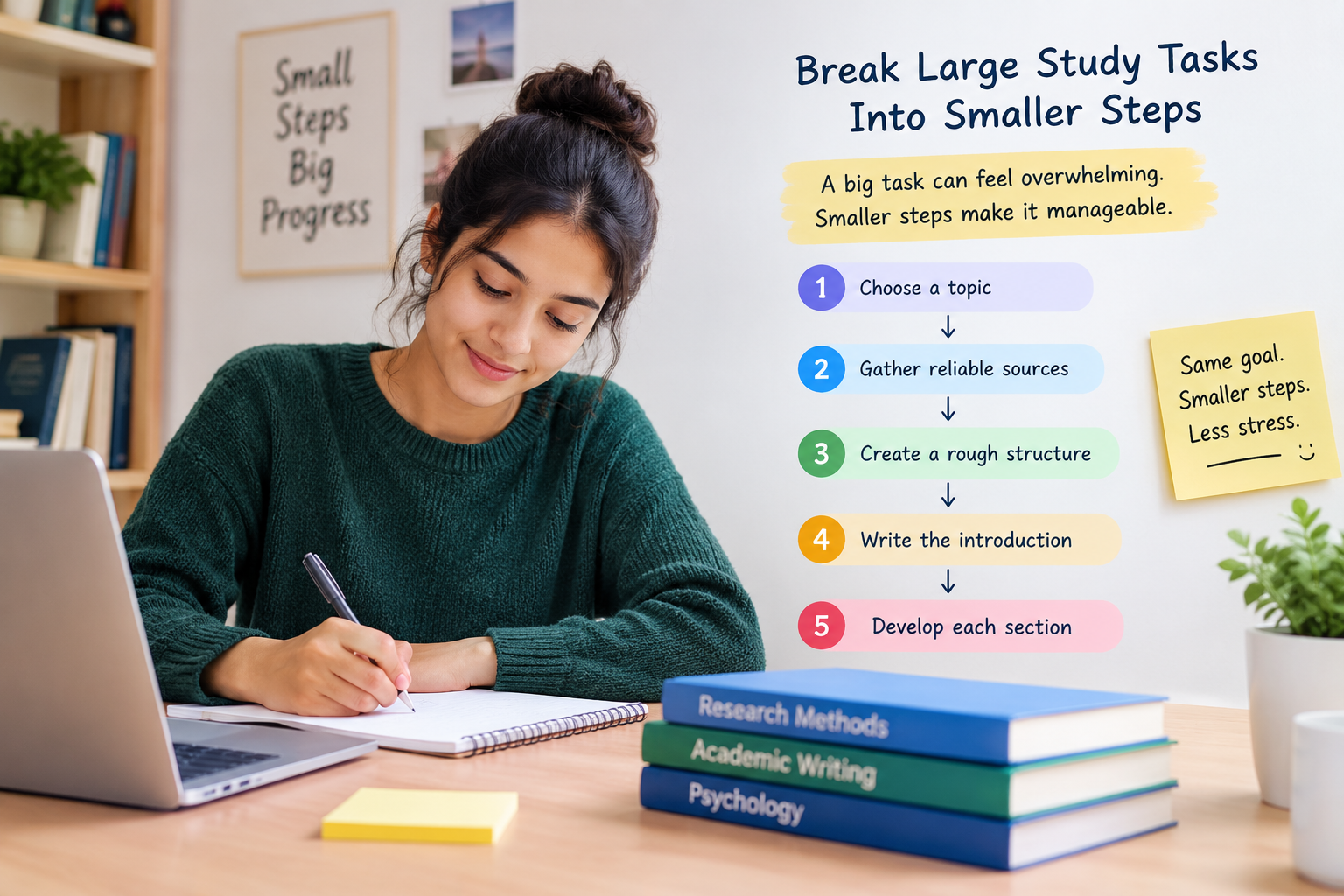
A large academic project becomes much less intimidating when it is divided into manageable pieces.
Suppose you have a 2,000-word assignment due next week. “Finish the assignment” is too broad to be useful as a first step. You could begin by choosing the topic, gathering reliable sources, creating a rough structure, writing the introduction, and then developing each section.
The same principle works for exam preparation. Instead of treating an entire subject as one enormous task, focus on a chapter, concept, group of questions, or specific learning objective.
The purpose is not to make the workload disappear. It is to remove the feeling that you have to handle everything at once.
Set a Clear Goal for Every Study Session
A productive study session should have a reason for existing.
You might want to understand one difficult concept, complete a set of practice questions, review a particular chapter, or turn lecture notes into a useful summary.
That is more meaningful than simply deciding to sit at your desk for two hours.
Time still matters, especially when you are planning around other responsibilities. But the amount of time spent studying does not tell you by itself whether the session was useful. A focused 30 minutes with a clear objective can accomplish more than two unfocused hours.
Use Short, Focused Study Sessions
If getting started feels difficult, do not immediately commit yourself to several hours of uninterrupted work.
Begin with a manageable period of focused study—perhaps 20 or 30 minutes—and then take a short break. If you still have the energy and concentration to continue, begin another session.
There is no single study-session length that works for everyone. The useful principle is to create a defined period in which one task receives your attention without unnecessary interruptions.
Short sessions can be especially helpful when you have been avoiding a subject for several days because the idea of a long session feels overwhelming.
Remove Distractions Before You Begin
Deal with distractions before they become a problem.
Silence unnecessary notifications, close unrelated browser tabs, and place your phone somewhere that makes casual checking less convenient. If you are studying online, keep only the websites and documents you actually need open.
This is more effective than relying on yourself to resist every notification once you are already trying to concentrate.
Your study environment can either support the behavior you want or repeatedly encourage the behavior you are trying to avoid. Research on academic procrastination has highlighted environmental and contextual factors as part of the problem.
Create a Consistent Study Routine
A predictable routine reduces the number of decisions you have to make before getting started.
If you usually study at a similar time and in a familiar place, beginning the session can gradually become a normal part of your day rather than something you have to negotiate with yourself every evening.
The routine does not need to be rigid. A simple schedule that survives busy days is more useful than an elaborate timetable that works for only a few days.
Time management also has a meaningful relationship with academic procrastination. A 2026 systematic review and meta-analysis involving 67 studies and more than 40,000 Chinese students found a significant negative correlation between time-management disposition and academic procrastination. Because this evidence focused on Chinese students, it should not automatically be treated as representative of every student population, but it supports the broader importance of managing study time effectively.
Use Realistic Deadlines
A final deadline can feel distant, especially when an assignment is due several days or weeks from now. Creating smaller deadlines along the way can make the work feel more immediate.
For a major assignment, decide when the research should be finished, when the first draft should be completed, and when you will edit the final version.
This approach prevents a large amount of work from collecting at the end of the schedule.
The deadlines should also be realistic. Giving yourself an impossible target can create the same overwhelm that caused the procrastination in the first place.
Take Intentional Breaks
Breaks are part of a sustainable study routine. The problem begins when a short break quietly turns into an hour of unrelated browsing.
A useful break has a clear boundary. You might get some water, stretch, walk around, or simply step away from your desk for a few minutes.
The purpose is to give your attention a chance to reset without turning the break into another form of avoidance.
Track Progress Instead of Waiting for Motivation
Large assignments can feel endless when you focus only on what remains.
Pay attention to what you have already completed. Maybe you reviewed a chapter, solved 15 questions, wrote two paragraphs, or finally understood a difficult concept.
Recognizing that progress changes the way the workload feels. Instead of seeing the entire assignment as one unfinished problem, you can see a series of tasks that are gradually being completed.
That shift can make it easier to return to the work during your next study session.
Reward Yourself After Completing Important Tasks
A small reward can give you something positive to look forward to after finishing a meaningful piece of work.
The reward does not need to be elaborate. It could be listening to music, taking a walk, talking with a friend, or spending some time on an activity you enjoy.
The important distinction is timing. If the reward comes before the work, it can easily become another distraction. If it follows a completed task, it can mark a clear transition from focused work to leisure.
How to Start Studying When You Have No Motivation
You can start studying without feeling motivated first. In many situations, the most practical solution is to reduce the task until beginning feels manageable.
Imagine that you have an exam in five days and several chapters still to review. Telling yourself that you need to study for six hours can create resistance before you even open the book. A more realistic starting point is to choose one chapter and commit to reviewing the first few pages for a short period.
The purpose of that first session is not to finish everything. It is to move from intending to study to actually studying.
Once you have started, keep your attention on the task in front of you rather than constantly thinking about how much work remains. If you finish the initial session and still have enough energy to continue, begin another one. If you do not, you have still made meaningful progress.
A useful question is:
What is the smallest meaningful study action I can take right now?
That question is usually more useful than asking whether you currently feel motivated.
How to Stay Focused Once You Start Studying
Starting is only half of the problem. Once the session begins, you also need to protect your attention.
Try to work on one task at a time instead of constantly switching between subjects, messages, websites, and assignments. Keep the materials you need nearby and remove anything that is likely to interrupt you.
You may also notice unrelated thoughts appearing while you study. Perhaps you remember an email you need to send or suddenly think about something you want to search online. Rather than immediately acting on the thought, write it down and return to your current task.
Your surroundings can make a noticeable difference. A quiet library, organized desk, or dedicated study area can help create a mental association between that environment and focused work.
At the same time, concentration has limits. Expecting yourself to maintain intense attention for hours without a break is rarely realistic. Structured sessions and deliberate breaks can create a more sustainable rhythm.
How to Stop Procrastinating Before Exams
Start exam preparation before the material becomes urgent.
Cramming creates unnecessary pressure because reading, understanding, practicing, and reviewing all have to compete for the same limited amount of time. Spreading the work across multiple sessions gives you more opportunities to identify weak areas before the exam arrives.
For example, if an exam covers six chapters, do not treat the syllabus as one giant assignment. Decide which chapter you will tackle first, what you need to understand, and when you will review the material again.
This also makes it easier to notice gaps in your knowledge while there is still time to address them.
Academic procrastination has been associated with poorer academic outcomes in several student populations. One study involving 1,019 university students found associations between greater procrastination and academic failure, as well as lower academic success. Because this was an observational study, however, the findings do not establish a simple cause-and-effect relationship.
The practical lesson is to avoid making the final few days before an exam responsible for your entire preparation.
What to Do When You Have Already Wasted Time
Once you realize that you have spent hours procrastinating, the temptation is to give up on the rest of the day.
Try not to.
If you have 45 minutes before dinner, use those 45 minutes. Pick one specific task and begin. You do not have to recover every lost minute immediately.
For example, if you intended to study at 2 p.m. but ended up scrolling on your phone until 5 p.m., there is little value in spending another hour feeling guilty about it. Open the material, decide what you can realistically accomplish, and start from there.
Avoid responding to a lost afternoon by creating an unrealistic late-night study marathon if that will leave you exhausted the following day. The goal is to restore productive behavior, not create another cycle of overwork and avoidance.
One delayed session does not have to determine what happens next.
How to Build Long-Term Study Habits That Reduce Procrastination
Long-term improvement comes from making productive behavior repeatable.
A simple routine is usually easier to maintain than a complicated productivity system. Choose realistic study times, decide what each session is for, and keep your study environment reasonably prepared.
It also helps to examine your own pattern of procrastination.
If you repeatedly postpone one particular subject, ask yourself what makes that subject different. Is the material difficult? Are the instructions unclear? Are you worried about making mistakes? Do you lose focus whenever you reach a certain type of assignment?
The answer can point toward a more useful solution.
Research increasingly treats academic procrastination as a behavior influenced by several interacting factors rather than as a simple character flaw. Recent research has connected it with self-regulation, time management, environmental conditions, and other academic and behavioral factors.
That is why a strategy that works perfectly for one student may not solve another student’s problem. The most effective routine is the one that addresses the reason you personally keep delaying the work.
Common Mistakes That Make Study Procrastination Worse
One of the biggest mistakes is creating a study plan that is more ambitious than your real schedule allows. A timetable that requires several hours of perfect concentration every day can quickly become discouraging when school, work, family responsibilities, or fatigue get in the way.
Another mistake is spending too much time preparing to study instead of actually studying. Reorganizing notes, switching productivity apps, redesigning schedules, or repeatedly searching for the “perfect” study method can feel productive while allowing the real task to remain untouched.
Vague goals are another problem. “Study biology” gives you no clear starting point. “Review Chapter 4 and answer the end-of-chapter questions” gives you something concrete to do.
It is also unhelpful to turn one delayed session into a judgment about yourself. Calling yourself lazy or undisciplined does not explain why the procrastination happened.
Instead, ask a more useful question: What is making this task difficult to start?
If the task is unclear, make it clearer. If your phone keeps interrupting you, change the environment. If the workload feels too large, divide it into smaller pieces.
The solution becomes much easier to see when the problem is described accurately.
When Procrastination Keeps Interfering With Studying
Occasional procrastination is common. Persistent difficulty completing academic responsibilities is a different situation and may deserve closer attention.
A systematic review of research involving medical students found that procrastination was associated in the literature with factors including stress, anxiety, self-esteem, metacognition, academic achievement, and mobile-phone addiction. These relationships are complex, and procrastination by itself does not establish a mental-health condition.
If procrastination is consistently interfering with your studies or causing significant distress, consider speaking with a teacher, academic adviser, counselor, or qualified health professional. Support can help determine whether the main issue is workload, study strategy, stress, attention, or another factor.
Asking for help is not a failure of discipline. Sometimes the most effective way forward is to identify the underlying obstacle rather than simply trying to push harder.
Frequently Asked Questions About Study Procrastination
Why do I procrastinate when studying?
Students may procrastinate because a task feels difficult, unclear, overwhelming, boring, or emotionally uncomfortable. Environmental distractions and difficulties with self-regulation can also contribute. Research suggests that academic procrastination has multiple personal and situational influences rather than one universal cause.
How can I stop procrastinating and start studying?
Choose one specific task that you can begin immediately, make it small enough to feel manageable, remove obvious distractions, and commit to a short focused session. “Study Chapter 3” is less actionable than “read pages 25–30 and answer the review questions.”
How do I study when I have no motivation?
Do not make motivation a requirement for starting. Choose a small, clearly defined task and begin with a short session. Once you have started, decide whether to continue based on how you are working rather than waiting for motivation to appear beforehand.
How can I avoid distractions while studying?
Prepare your environment before the session begins. Silence unnecessary notifications, move your phone away if possible, close unrelated browser tabs, and keep only the materials needed for the current task within reach.
How do I stop procrastinating before exams?
Begin preparation earlier and divide the syllabus into manageable study sessions. Schedule opportunities to review the material before the final deadline instead of relying on last-minute cramming.
What is the 5-minute rule for procrastination?
The basic idea is to commit to working on a task for just five minutes. The purpose is to lower the psychological barrier to starting, not to suggest that five minutes will always be enough to finish. If you want to continue after five minutes, keep going.
