

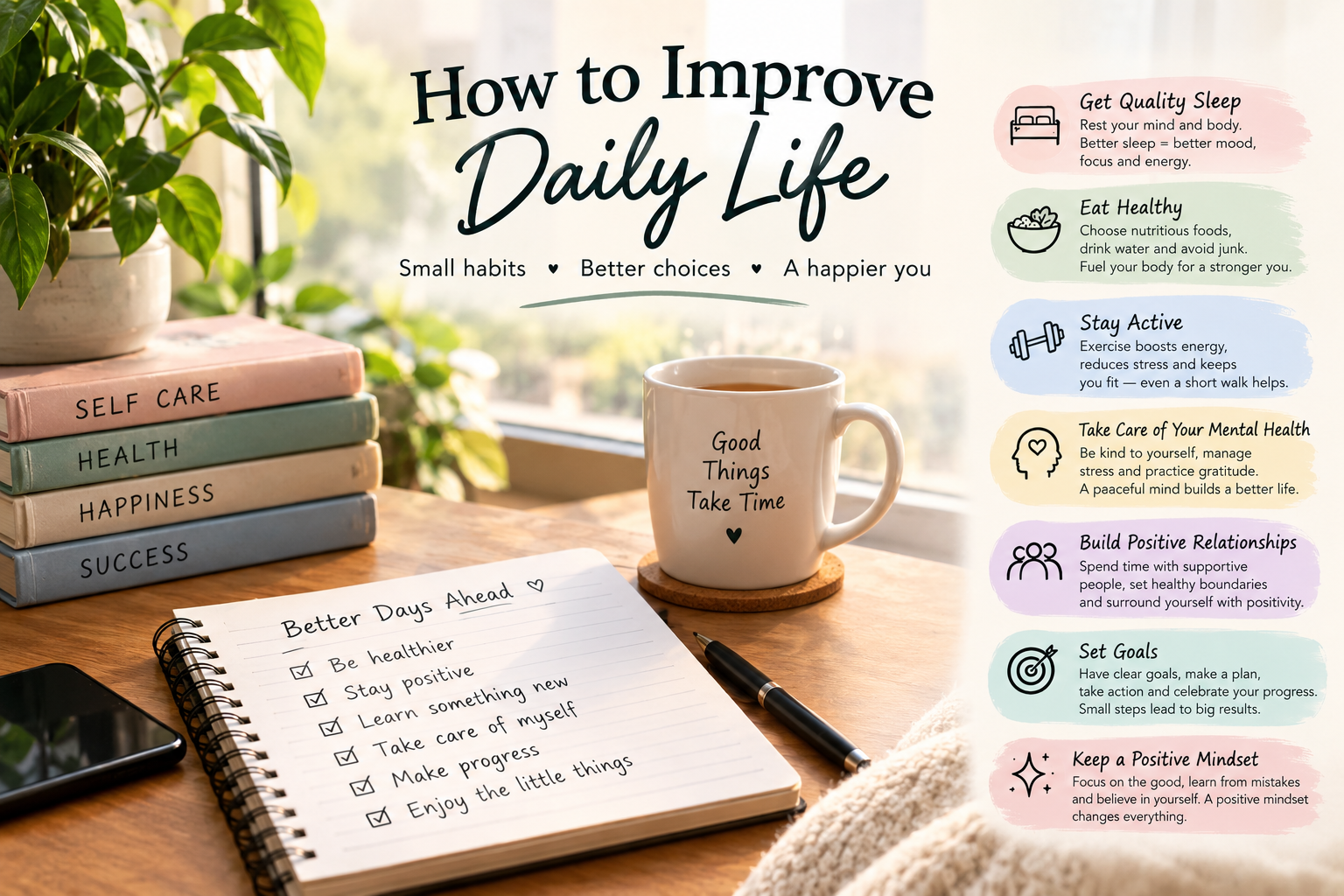
Improving daily life comes down to optimizing the small, repeatable actions that shape your day. That means improving how you sleep, how you focus, how you spend your energy, and how you manage your environment and relationships. You don’t need a complete overhaul. Small, sustainable habits in these four areas compound into better energy, clearer focus, and a daily life that actually feels good, even without constant motivation.
How to Improve Daily Life: 8 Small Changes That Actually Make a Big Difference
You probably don’t need a new life. You need a better way to live the one you have.
Most of us know what we should be doing. Sleep more. Scroll less. Move a little. Stress a little less. The issue is that most advice asks you to become someone else by Monday morning. That never sticks.
Daily life improves differently. It improves through tiny, intentional adjustments that still work on a busy, tired, imperfect day. That’s what this guide is built around.
What Does Improving Your Daily Life Really Mean?
Improving your daily life means making your normal days feel better, not just your best days.
It is not about hacking every hour or building a perfect-looking morning routine. It is about four foundations that run in the background of every day. Your physical foundation — how you sleep, eat, and move. Your mental foundation — how you handle stress, emotions, and focus. Your time and energy foundation — what you actually give your attention to. And your environment — your space and the people you see every day.
When one of those slips, the whole day feels harder than it should. When you make small improvements across all four, the quality of your everyday life starts to shift.
Why It’s So Hard to Improve Daily Life
It’s hard because your brain is wired to save energy, not to improve your life.
Every habit runs on a loop. Cue, craving, response, reward. You wake up — that’s the cue. You crave a little hit of novelty. You grab your phone — that’s the response. You get dopamine — that’s the reward. If you want a different day, you have to change the loop, not just try harder.
Three things usually get in the way. The first is friction. If the good habit takes effort and the bad habit is effortless, the bad habit wins. The second is decision fatigue. When you have to make too many choices about your day, your brain gets tired and defaults to the easiest option. The third is identity. As James Clear puts it in Atomic Habits, lasting change is identity-based. You don’t just want to journal more; you want to be someone who pauses to reflect. Without that shift, motivation fades after a few days.
Once you get this part, the actual tactics become much easier. Make good habits easier to start. Make bad habits harder to start. That’s the whole game.
How to Improve Daily Life: The 8 Core Pillars
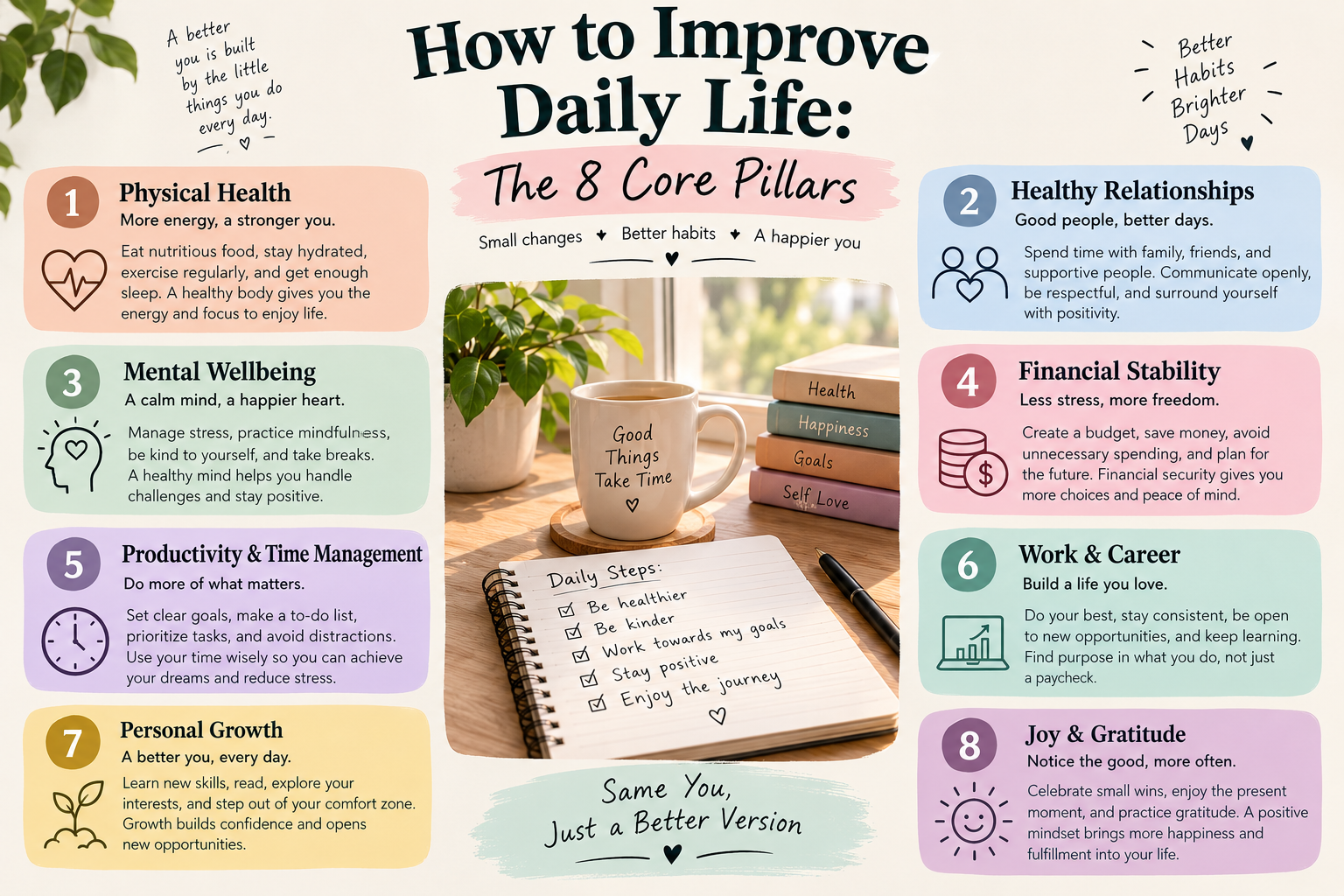
You don’t need thirty new habits. You need a simple system built on eight pillars that work together. Think of this as a minimum viable routine. You can shape it to fit a student schedule, a work-from-home day, or a house full of kids.
1. Design a Morning Routine That Gives You Momentum, Not Stress
A good morning routine is about momentum. Not about waking up at 5 a.m. and cramming in ten tasks before breakfast.
Your body follows a circadian rhythm, your internal 24-hour clock that governs sleep and energy. Getting natural light in the first hour after you wake is one of the strongest signals you can give that clock. Neuroscientists like Andrew Huberman at Stanford talk about this a lot because it genuinely improves daytime energy and nighttime sleep.
Keep it short. Light, water, movement. Open the blinds or step outside for a couple of minutes. Have water before coffee. Stretch or walk for a minute or two. Then give your attention to one meaningful task before you check email or social media. That early win matters. It puts you in charge of the day before the day starts demanding things from you.
2. Build Tiny Habits That Stick With the 1% Rule
The habits that last are almost always small. That’s the logic behind the 1% rule. Get one percent better each day, and the compounding over months is significant.
Habit stacking makes that practical. You don’t build a new habit from nothing; you attach it to something you already do without thinking. After I brush my teeth, I will write one sentence in my journal. After I pour coffee, I will breathe for one minute. The old habit becomes the reminder for the new one.
And use the two-minute rule to lower the barrier. Shrink any new habit until it takes less than two minutes to start. Want to read more? Read one page. Want to exercise? Just put on your workout clothes. At first, you are not chasing the result. You are proving to yourself that you are the kind of person who shows up. People fail here because they start too big. Start so small you can’t talk yourself out of it, then let consistency do the heavy lifting.
3. Take Control of Your Time and Energy
You can’t actually manage time. You can only manage what you do with your attention and energy inside that time.
Most of us spend the day in shallow work. Answering messages, switching tabs, feeling busy without getting much done. Cal Newport calls the opposite deep work — focused, undistracted time on something that actually requires thought. That is where progress comes from.
Time blocking helps. Instead of a long to-do list you keep re-reading, give your important tasks a home on your calendar. Say, 9:00 to 10:30 for writing, phone on Do Not Disturb. Outside those blocks, you can handle the smaller stuff. Also pay attention to your energy, not just your hours. Most people have a clear peak in the morning. Guard that window for your hardest work and leave low-energy hours for admin. You will get more done without working more hours.
4. Fix Your Physical Foundation: Sleep, Movement, and Food
If your physical foundation is shaky, no productivity system will save your day.
Sleep hygiene is just a term for the habits that make good sleep more likely. A consistent sleep and wake time, even on weekends. Dimmer lights in the evening. A cool, dark room. The National Sleep Foundation recommends seven to nine hours for adults, but consistency matters just as much as duration. One late night can throw off two good ones.
For movement, forget the idea that you need an hour in the gym every day to benefit. Your body wants regular movement more than occasional intensity. A twenty-minute walk, some bodyweight squats, taking the stairs — done consistently, that does more for energy and mood than a hard workout you only manage twice a month.
With food, think addition rather than restriction. Add protein to breakfast. Add water before your second coffee. Add one vegetable to lunch. When you focus on adding the good stuff, there is naturally less room for what leaves you tired.
5. Strengthen Your Mental Health Every Day
Mental health is not something you fix once and forget about. It’s daily maintenance, like brushing your teeth.
Two practices have the best evidence for day-to-day mental well-being. The first is mindfulness, which is just noticing the present moment without immediately judging it. You don’t need thirty minutes on a cushion. Five minutes of paying attention to your breathing, or eating your first meal without your phone in hand, trains your brain to be less reactive.
The second is getting thoughts out of your head and onto paper. Journaling doesn’t have to be eloquent. A short brain dump at night — what worried you today, what your top three tasks are for tomorrow, and one thing that went well — reduces rumination. The American Psychological Association has consistently linked expressive writing and simple gratitude practices to lower stress and better mood. If the day felt messy, ask yourself what you can let go of before bed. That question alone creates a little closure.
6. Declutter Your Space and Your Digital Life
Your environment is influencing your behavior more than you think. A cluttered desk raises cognitive load. A phone buzzing every few minutes fractures your attention.
Start with your physical space. Pick one surface. Your desk. Your kitchen counter. Keep that one surface clear. That visual calm signals to your brain that things are under control. You don’t need to become a minimalist. You just need less friction to find what you actually need.
The digital side is often bigger. The average person checks their phone more than ninety times a day. Each check is a small break in focus. Make distraction harder and focus easier. Take social apps off your home screen. Turn off every notification that isn’t from a real person. Set limits that actually stop you. A lot of people find that charging their phone outside the bedroom and buying a ten-dollar alarm clock is the single best change they’ve made to their daily life.
7. Improve Your Relationships and Social Connection
Long-term research on well-being, including the Harvard Study of Adult Development, keeps landing in the same place: the quality of your relationships predicts happiness more reliably than income or achievement.
Improving daily life means being more intentional about connection. It doesn’t mean seeing more people. It means having better moments with the people already around you. Try active listening in one conversation a day. Phone away, eyes up, listening to understand instead of waiting to reply. Send one appreciative message. It takes thirty seconds and it strengthens the bond.
Boundaries are part of this too. If certain group chats, feeds, or conversations consistently drain you, it’s reasonable to mute, limit, or say no. Protecting your energy is not selfish. It’s what allows you to show up well for people.
8. End Your Day With Reflection, Not Regret
How you end your day shapes how you start the next one. If you scroll until you fall asleep, that stimulation follows you into the night.
An evening routine doesn’t need to be long. It needs to create a clear line between day and rest. Dim the lights an hour before bed. Do a quick reset — clothes ready, kitchen tidy. Then take three minutes to close the loop. One win from today. One thing that felt hard. One thing that matters most tomorrow.
Your brain holds onto unfinished tasks more than finished ones — psychologists call this the Zeigarnik effect. That’s why we lie awake replaying tomorrow. Writing tomorrow’s plan down tells your brain it’s safe to let go. You improve not just tonight, but tomorrow morning too.
How to Improve Daily Life When You Have No Motivation
You won’t always feel motivated. You don’t need to be. Motivation is unreliable. Systems are not.
On low-energy days, use a Minimum Viable Day. What is the smallest version of your routine that still counts as a win? Maybe it’s drinking water, making your bed, and a ten-minute walk. That’s enough. The key rule is never miss twice. Missing once is human. Missing twice is the start of a different habit — the habit of quitting.
If you feel stuck, make the task so small it feels almost silly. Tell yourself you will work for five minutes. Starting is usually the hardest part. Once you’re moving, you tend to keep moving. And be decent to yourself when you slip. Research on self-compassion shows that people who are kind to themselves after a setback are more likely to get back on track than those who beat themselves up. Improvement isn’t about being perfect. It’s about returning.
5 Common Mistakes That Make Your Daily Life Worse
One of the most common mistakes is trying to change everything on Monday. New diet, new workout, new morning routine, new journaling habit all at once. You will burn out by Wednesday. Change one pillar at a time and give it a week.
Another is comparing your routine to what you see online. Social media shows you the highlight, not the messy middle. Your life has different constraints, different responsibilities, and different energy. Build a routine that fits your actual life.
A third is relying on motivation instead of your environment. If your phone is next to your bed, you will check it. If snacks are on the counter, you will eat them. Design your environment so the good choice is the easy one.
A fourth is stealing from sleep to get more done. It feels productive in the moment, but poor sleep weakens focus, mood, and decision-making the next day. You don’t gain time; you borrow it at high interest. Protect sleep as non-negotiable.
And the last is consuming self-improvement content without doing anything with it. Learning feels productive, but if you never apply one idea, it becomes another form of procrastination. For every article or video, apply one thing right away, even in a tiny way.
How to Make These Changes Last
Lasting change comes from tracking and reviewing, not just doing.
Pick one metric that actually matters to you. Hours slept. Minutes walked. Days you completed your morning routine. Track it in the simplest way possible — an X on a calendar, a note on your phone. Seeing a chain of wins is quietly motivating.
Then, once a week, take ten minutes to review. What worked this week? What didn’t? What will I tweak next week? This little loop keeps you from drifting back into old patterns and lets you adapt the system as life changes. Improvement is not a straight line. Some weeks will be messy. The weekly review is how you course-correct without guilt.
The best daily routine is the one you can keep for years, not the one that looks impressive for seven days. Start with one pillar from above. Practice it for a week. Then add another. Small, consistent improvements compound into a life that feels better to live.
Read more: How to Improve Mental Health and Wellness Naturally
