

A full academic schedule does not necessarily mean a productive one. Many students spend hours attending classes, reading textbooks, and working on assignments, yet still feel as though they are falling behind.
Often, the problem has less to do with effort and more to do with how that effort is being used. Constant phone notifications, poorly planned study sessions, delayed assignments, and ineffective revision methods can make even a manageable workload feel exhausting.
The pressure becomes greater when students are expected to balance education with family responsibilities, part-time jobs, social commitments, and personal goals. Without a practical routine, it is easy for important tasks to pile up.
Improving productivity does not require a complete lifestyle overhaul. A few thoughtful changes to the way you plan, study, and manage your attention can make a noticeable difference.
This guide explores 15 student productivity tips for 2026, with practical advice on managing time, improving concentration, developing stronger study habits, and making academic progress without sacrificing personal well-being.
What Is Student Productivity and Why Does It Matter?
Student productivity is the ability to use time, energy, and learning resources effectively to meet academic goals. It involves completing assignments, understanding course material, preparing for examinations, and keeping up with deadlines without making studying unnecessarily difficult.
It is easy to confuse productivity with the number of hours spent at a desk. However, time alone does not tell you how much someone has learned. A student who spends two focused hours understanding a difficult subject may make more progress than someone who spends five hours reading while regularly checking their phone.
Good academic productivity also requires judgment. Students need to recognize which assignments deserve immediate attention, which subjects need additional revision, and when taking a break is more useful than continuing to work.
15 Best Student Productivity Tips for 2026
Better study habits rarely develop overnight. The most effective changes are usually small enough to maintain and practical enough to fit into an ordinary student schedule.
1. Set Clear and Achievable Academic Goals

It is much easier to make progress when you know exactly what you are working towards. Clear academic goals give study sessions a purpose and help prevent time from disappearing into unplanned activities.
Start by replacing broad intentions with specific outcomes. Instead of writing “study biology” on your daily schedule, decide to review a particular chapter, summarize its main concepts, or answer a set of practice questions.
The SMART goal framework provides a useful way to approach this. It encourages goals that are specific, measurable, achievable, relevant, and time-bound.
2. Create a Realistic Daily Study Schedule
A well-planned study schedule helps students stay organized without allowing assignments and revision to take over the entire day.
Begin with the commitments you cannot easily change. These might include school or university classes, commuting, work, family responsibilities, and scheduled activities. Once those are accounted for, identify suitable periods for independent study.
Your schedule should reflect your actual energy levels. Some students find it easier to concentrate in the morning, while others do their best work later in the afternoon or evening.
For instance, a university student with morning lectures might reserve the afternoon for assignments and use a shorter evening session to review class notes. Someone with evening classes may prefer completing demanding work earlier in the day.
3. Prioritize Important Academic Tasks
Not every assignment deserves the same level of attention at the same time. Learning to distinguish urgent work from important long-term responsibilities can make a considerable difference to student time management.
Before starting your day, review your upcoming deadlines and identify which tasks require the most attention. Consider how much work each one involves, when it is due, and whether delaying it could create problems later.
The Eisenhower Matrix offers one way to organize these decisions. It separates responsibilities into four groups: urgent and important, important but not urgent, urgent but less important, and neither urgent nor important.
Imagine you have an assignment due tomorrow and an examination scheduled several weeks away. The assignment needs immediate attention, but the examination preparation should not be ignored until the final few days.
4. Break Large Assignments Into Smaller Steps
A major assignment can feel difficult before you have even started working on it. The simplest way to make it more manageable is to stop treating it as one enormous task.
Consider a research paper. Completing the entire project may seem intimidating, particularly when you have several other subjects to manage. Breaking it into stages gives you a clearer starting point.
You might begin with background research, move on to selecting reliable sources, prepare an outline, write the first draft, and finish with editing and proofreading.
This method is particularly helpful for students who procrastinate because they are unsure how to begin. A small task, such as reading two pages or finding three relevant sources, feels much less demanding than completing an entire project.
Give each stage a realistic deadline as well. Otherwise, breaking an assignment into smaller pieces can simply create more opportunities to postpone it.
5. Use the Pomodoro Technique to Improve Focus
Long study sessions are not always the best way to maintain concentration. For students who frequently lose focus or become mentally tired, the Pomodoro Technique offers a straightforward alternative.
The method divides work into focused periods separated by short breaks. Its traditional format involves 25 minutes of concentrated work followed by a five-minute break. After four sessions, you take a longer break.
During each work period, concentrate on one clearly defined task. If you are reviewing a lecture, stay with that material rather than switching between subjects, messages, and unrelated websites.
The technique works particularly well for tasks that are easy to postpone, such as reviewing notes, completing practice questions, or starting an assignment.
However, the 25-minute format is not a rule that every student must follow. Writing a detailed essay or solving a difficult problem may require a longer uninterrupted period. In those situations, 40- or 50-minute sessions may be more appropriate.
6. Practice Active Recall and Spaced Repetition
Reading your notes repeatedly can make information feel familiar, but familiarity does not always mean you can remember or explain what you have learned. Active recall and spaced repetition address this problem in different but complementary ways.
Active recall involves retrieving information from memory without immediately looking at your notes. After studying a topic, close your textbook and try to explain its main ideas. You can also answer practice questions, solve problems, or use flashcards to test your understanding.
Spaced repetition focuses on when you review information. Instead of studying the same topic repeatedly in one session, revisit it across several study sessions separated by time.
A useful approach is to begin each revision session with a short memory test. Identify what you cannot remember, review those areas, and test yourself again. This makes revision more purposeful than simply rereading entire chapters.
The Institute of Education Sciences recommends learning practices that include spacing study over time and using quizzes to strengthen learning. These approaches are particularly useful for students preparing for examinations or trying to retain information across an academic term.
7. Eliminate Digital Distractions While Studying
A smartphone can be an excellent learning tool, but it can also become one of the biggest obstacles to concentration.
Social media notifications, messaging applications, short videos, and unrelated browsing all compete for attention. Even a brief interruption can break your concentration and make it harder to return to the task you were working on.
Start by identifying what interrupts you most often. If you regularly check messages, silence nonessential notifications during study periods. If social media tends to pull you away from assignments, keep those applications closed until your work is finished.
You can also place your phone in another room or leave it somewhere out of reach. For students who prefer additional structure, website blockers and screen-time settings can help limit access to distracting applications.
Tools such as Forest offer a way to encourage phone-free study periods, although you do not need a dedicated application to develop better digital habits.
Technology itself is not the problem. Online lectures, educational videos, digital libraries, and learning platforms are valuable resources. What matters is being deliberate about when and why you use them.
8. Create a Focused Study Environment
Your surroundings can influence how easily you settle into a study session. A cluttered desk, constant background noise, or missing materials can make it harder to concentrate.
A productive study environment does not need to be expensive or elaborate. A quiet corner with sufficient lighting, a comfortable chair, and enough space for your books and laptop is often sufficient.
Before beginning, gather the materials you expect to need. Keeping notebooks, pens, textbooks, and other resources within reach prevents unnecessary interruptions.
Noise is another factor worth considering. Some students prefer complete silence, while others find low-level background noise helpful. If your home is busy, a library or another quieter location may provide a better place to work.
Students who share bedrooms or live in crowded households may have limited control over their surroundings. In that case, choosing quieter times of day or establishing a consistent study area can still help.
Do not spend too much time trying to create a perfect workspace, though. A comfortable and practical environment is all you need to get started.
9. Avoid Multitasking and Focus on One Task at a Time
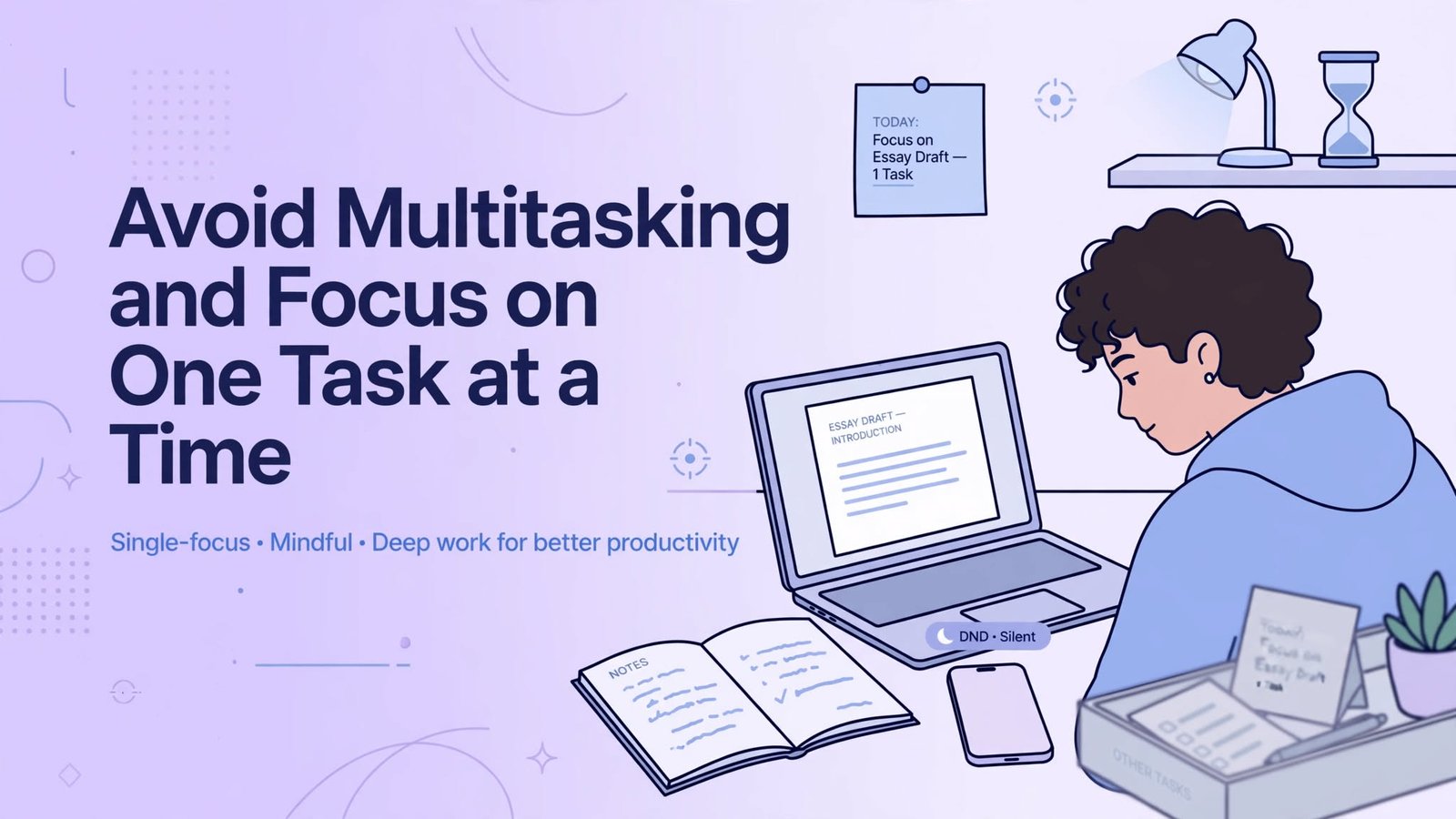
Trying to handle several demanding activities simultaneously can make academic work slower and more difficult.
A student who writes an essay while responding to messages, watching videos, and switching between unrelated subjects is constantly redirecting attention. This can interrupt the thought process needed for reading, writing, and problem-solving.
Single-tasking offers a more straightforward approach. Choose one activity, give it your attention, and move to the next responsibility when you have completed a meaningful portion of the first.
For example, if you are preparing an assignment, focus on researching or drafting before switching to another subject. Once that session is complete, you can review your other priorities.
It also helps to keep a separate note for unrelated tasks that come to mind while studying. If you suddenly remember an email you need to send or a book you need to borrow, write it down and return to your work.
This small habit prevents minor thoughts from repeatedly interrupting your concentration.
10. Start With Difficult or Important Tasks
The order in which you approach your work can influence how much you accomplish during the day.
Students often begin with easy activities because they are comfortable and provide quick results. However, spending too much time on minor tasks can leave demanding assignments until the point when concentration and energy have already declined.
Try scheduling challenging work during the hours when you feel most alert.
For one student, that might mean solving mathematics problems in the morning. Another may find that writing essays or reading complex material is easier in the evening.
The key is to recognize your own working patterns rather than following a routine simply because someone else recommends it.
Starting with important tasks does not mean every difficult assignment must be completed immediately. You can begin with a manageable part of the work and build momentum from there.
What matters is making meaningful progress before smaller responsibilities consume the time you need for more demanding activities.
11. Organize Notes and Study Materials
Searching through scattered documents, misplaced notebooks, and unorganized folders wastes time that could be spent learning.
A simple organizational system makes it easier to find course materials, prepare for examinations, and keep track of assignments.
For handwritten notes, use separate notebooks or clearly divided sections for each subject. If you prefer digital organization, create folders with consistent names for lectures, assignments, revision material, and reference documents.
Applications such as Notion can help organize notes and academic projects, while Google Drive provides convenient access to documents across devices.
It is also worth reviewing your notes shortly after each class. Fill in missing explanations, correct mistakes, and identify concepts that need further attention while the lesson is still fresh.
Avoid making your system unnecessarily complicated. You do not need elaborate folders or detailed templates for every subject.
A straightforward arrangement that you can maintain throughout the academic year is far more useful than an impressive system you stop using after a few weeks.
12. Use Productivity Tools Wisely
Digital productivity tools can help students organize assignments, manage deadlines, and keep study materials accessible. Their value depends on whether they solve a specific problem in your academic routine.
For scheduling, Google Calendar can help organize lectures, examinations, assignment deadlines, and revision sessions. Students who struggle to remember individual tasks may find Todoist useful for managing smaller responsibilities. Notion can provide a more flexible space for organizing notes, study resources, and academic projects.
The best approach is to choose tools based on your needs rather than installing several applications at once. A calendar and a simple task manager may be enough for many students.
AI tools can also support learning when used thoughtfully. Students can ask for explanations of difficult concepts, generate practice questions, explore alternative explanations, or organize revision topics. However, AI-generated information should be checked against reliable learning materials, and students should follow their institution’s academic integrity policies.
Technology should reduce unnecessary work, not become another responsibility. If maintaining a productivity application takes more time than completing the tasks inside it, simplify your system.
13. Build Consistent Study Habits
Consistency often matters more than occasional bursts of intense effort. Studying for several hours one day and doing almost nothing for the next few days can make it difficult to maintain progress. A more manageable approach is to develop small habits that fit naturally into your routine.
For example, you might review lecture notes for 15 minutes after class, revise one topic each evening, or spend a few minutes preparing for the following day’s lessons.
It can help to connect a new habit to something you already do regularly. Reviewing notes after lunch or preparing your study materials before going to bed gives the activity a natural place in your day. Do not expect every session to go perfectly. Illness, family responsibilities, unexpected deadlines, and other interruptions are part of student life.
If you miss a planned session, return to your routine when you can. One disrupted day does not undo the progress you have already made. The aim is to build a pattern of studying that remains manageable throughout the academic year, rather than relying on motivation to carry you through every assignment.
14. Take Regular Breaks to Prevent Mental Fatigue
Studying continuously for hours may seem like a productive use of time, but concentration does not remain at the same level indefinitely. As mental fatigue builds, students may find it harder to follow explanations, solve problems, or remember what they have just read. Short breaks provide an opportunity to step away from the material and return with a clearer mind.
The right break schedule depends on the task. After a focused study session, a few minutes of walking, stretching, drinking water, or resting your eyes may be enough. Try to choose activities that make it easy to return to your work. Checking social media can turn a short break into an extended distraction, particularly when you are already struggling to concentrate.
It is also important to recognize when you need a longer rest. If you have been working on a demanding assignment for several hours, a proper meal or some time away from your desk may be more useful than another short pause. Rest is part of a sustainable study routine, not a reward that students must earn by exhausting themselves first.
15. Get Enough Sleep and Maintain a Healthy Study-Life Balance
Sleep plays an important role in attention, memory, learning, and general well-being. Students who regularly sacrifice rest to gain extra study hours may eventually find it harder to concentrate and retain information.
The amount of sleep needed varies with age. The CDC recommends 8–10 hours for teenagers aged 13–17 and at least seven hours for most adults aged 18–60. Maintaining a reasonably consistent bedtime and waking time can help support a healthier routine. It is also worth avoiding the habit of leaving important assignments until late at night, when tiredness can make demanding work more difficult.
Academic responsibilities should not occupy every part of your life. Physical activity, regular meals, family time, hobbies, and social relationships all contribute to overall well-being. If you frequently feel exhausted or overwhelmed, look at the demands of your schedule before adding more study hours. You may need to adjust your workload, make better use of focused sessions, or allow more time for rest. A sustainable routine is one you can maintain without constantly feeling drained.
How to Create a Productive Daily Routine as a Student
A productive daily routine should fit your classes, responsibilities, energy levels, and personal commitments. There is no single timetable that works for every student.
Start by identifying the fixed parts of your day, including lectures, commuting, work, and family responsibilities. These provide the structure around which you can plan independent study.
For example, a student attending morning classes might spend a short period reviewing lecture notes after returning home, work on an assignment in the afternoon, and use the evening to revise a difficult topic.
Someone with evening classes may find that the morning is a better time for demanding academic work.
The important thing is to give priority tasks enough attention without making the schedule unnecessarily restrictive. Include time for breaks, meals, and personal activities rather than treating them as interruptions.
Preparing for the next day can also make mornings less stressful. Before finishing your evening routine, check upcoming deadlines, organize the materials you need, and decide which academic task deserves attention first.
As your responsibilities change throughout the semester, adjust your schedule accordingly. A useful routine should support your education, not become another source of pressure.
Common Productivity Mistakes Students Should Avoid
Students sometimes struggle with productivity because their study methods create unnecessary work rather than helping them make progress.
One common problem is creating a timetable that leaves no room for unexpected responsibilities. A schedule may look organized on paper, but if every hour is occupied, even a small interruption can disrupt the entire day. Build flexibility into your routine and prioritize the most important tasks first.
Another mistake is confusing preparation with progress. Spending excessive time selecting applications, organizing folders, or rewriting notes can create the feeling of productivity without improving understanding. Organization should make studying easier, not replace it.
Passive revision is another area worth reconsidering. Reading the same chapter several times may make the material familiar, but students should also test whether they can explain the concepts without looking at their notes. Practice questions and active recall provide a clearer indication of understanding.
Students should also avoid treating sleep and breaks as optional. Consistently sacrificing rest to gain additional study hours can make concentration and learning more difficult.
If your study routine repeatedly fails, do not immediately assume you lack discipline. Look at the underlying problem. You may have unrealistic deadlines, too many competing responsibilities, frequent distractions, or study sessions that are too long for the task.
The solution is to identify the specific obstacle and adjust your approach. A realistic routine that you can maintain is more valuable than an ambitious schedule that repeatedly breaks down.
How to Stay Productive During Exams
Examination periods can put considerable pressure on students, particularly when several subjects require attention at the same time. A clear revision plan makes it easier to manage the workload and avoid leaving everything until the final few days.
Begin by reviewing your examination schedule and identifying the subjects that need the most preparation. Divide each subject into individual topics, then allocate study sessions according to their difficulty and importance.
Try to spread revision across several days rather than attempting to cover large amounts of material in one sitting. This gives you repeated opportunities to review information and identify areas that need more attention.
Active recall is particularly useful during this period. After studying a topic, close your notes and try to answer questions from memory. Practice papers can also help you understand the examination format, identify gaps in your knowledge, and become more comfortable working within time limits.
One mistake students often make is spending too much time revising familiar topics because they feel easier. Give difficult material enough attention, even when it requires more effort.
Sleep should remain part of your examination routine. Staying awake all night may provide additional study time, but exhaustion can make concentration and memory less reliable.
If the workload starts to feel overwhelming, narrow your attention to one manageable task. Completing a focused revision session is more useful than spending an entire evening worrying about everything still left to do.
Frequently Asked Questions About Student Productivity
What Are the Best Productivity Tips for Students in 2026?
The most useful productivity habits include setting clear academic goals, planning study sessions, prioritizing assignments, reducing distractions, and using effective learning techniques such as active recall and spaced repetition. Maintaining a consistent routine and getting enough sleep also help students manage their responsibilities more effectively.
How Can I Become a More Productive Student?
Start by identifying what is getting in the way of your studies. If you regularly postpone assignments, divide them into smaller tasks. If you struggle with concentration, reduce distractions and work in focused sessions. When your workload feels overwhelming, create a realistic schedule and decide which responsibilities need attention first.
How Can Students Manage Their Time Effectively?
Students can manage their time by reviewing weekly responsibilities, setting daily priorities, scheduling study sessions, and keeping track of assignment deadlines. It is also helpful to leave some flexibility in the schedule so unexpected tasks do not disrupt the entire routine.
What Is the Best Daily Study Routine for Students?
The best daily study routine is one that fits a student’s classes, responsibilities, and concentration patterns. It should include dedicated study sessions, regular revision, time for assignments, breaks, and sufficient sleep. A routine that can be maintained consistently is more useful than a strict timetable that becomes difficult to follow.
How Can I Stop Procrastinating on Assignments?
Begin by dividing the assignment into smaller tasks with individual deadlines. Instead of worrying about completing the entire project, choose one specific action, such as researching a topic or preparing an outline. Removing distractions and deciding exactly what to do next can make it easier to get started.
How Can I Stay Focused While Studying?
Choose one task at a time, silence unnecessary notifications, and prepare your study materials before beginning. Focused study sessions followed by short breaks can also help maintain concentration. If you regularly lose attention, consider whether your study environment or schedule needs adjusting.
What Is the Pomodoro Technique for Students?
The Pomodoro Technique is a time-management method that divides work into focused sessions separated by short breaks. Its traditional format uses 25 minutes of concentrated work followed by a five-minute break. Students can adjust the intervals to suit their concentration levels and the type of task they are completing.
How Can I Study Smarter Instead of Harder?
Focus on learning methods that require active engagement with information. Active recall, spaced repetition, and practice testing help students check their understanding and revisit material over time. These methods are generally more useful than relying entirely on repeated reading.
What Are the Best Free Productivity Apps for Students?
Several useful options offer free plans or free features. Google Calendar can help with scheduling, Notion supports note organization, Todoist manages tasks, and Forest encourages focused study sessions. Available features and pricing can change, so check each application’s current plan before choosing one.
How Much Sleep Do Students Need to Stay Productive?
Sleep requirements depend on age. Teenagers aged 13–17 generally need 8–10 hours each night, while most adults aged 18–60 need at least seven hours. Getting enough sleep supports attention, memory, learning, and general health.
