

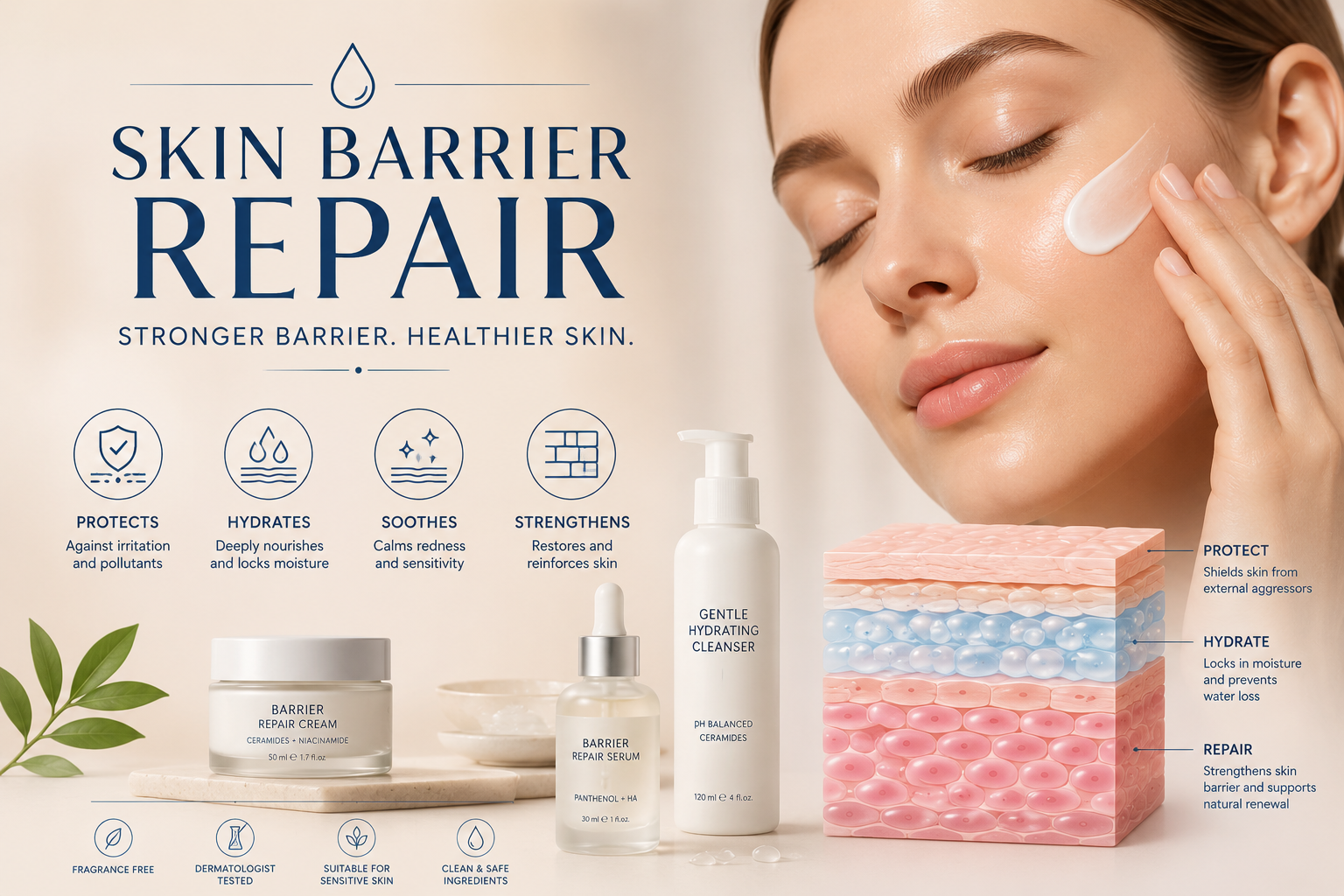
Skin barrier repair is the process of restoring your stratum corneum’s lipid matrix — the blend of ceramides, cholesterol, and fatty acids that keeps water in and irritants out. To repair a damaged barrier, you pause actives like AHA, BHA and retinol, switch to a low-pH gentle cleanser, and replenish daily with a ceramide-dominant moisturizer. Most barriers rebound in 2 to 4 weeks.
If your skin feels tight the minute you wash it, stings when you apply anything, and stays red no matter how much moisturizer you use, you are not just dry. Your barrier is compromised. And no amount of hydrating serum will help until you fix the structure underneath.
What Is Your Skin Barrier and Why Does It Matter?
Your skin barrier is the outermost layer of your skin, the stratum corneum. The easiest way to picture it is a brick wall. The corneocytes, your dead skin cells, are the bricks. The mortar is a precise mix of lipids — ceramides, cholesterol, and fatty acids. When that mortar is intact, your skin feels calm, holds hydration, and handles products without drama. When it cracks, water escapes and everything irritates.
It has two jobs that matter more than anything else in your routine. First, it prevents transepidermal water loss, or TEWL, the invisible evaporation of water from inside your body. Second, it blocks bacteria, pollution, allergens, and harsh ingredients from getting in.
People often use skin barrier, acid mantle, and microbiome like they mean the same thing. They don’t, but they depend on each other. The acid mantle is the thin, slightly acidic film sitting on top of your wall, keeping your pH around 4.7 to 5.5 where healthy enzymes can work. The microbiome is the community of good bacteria living on that film. Break the lipid wall and your pH climbs, your microbiome shifts, and your skin becomes reactive. You have to rebuild the wall first.
The Role of Ceramides, Cholesterol, and Fatty Acids
Not all moisturizers repair. Some just feel nice for an hour. Real repair requires replacing what is missing in the ratio your skin actually uses — roughly 50% ceramides, 25% cholesterol, and 15% fatty acids. This 50:25:15 balance is what studies on biomimetic formulations point to as optimal for restoring barrier function. A product with only petrolatum or only hyaluronic acid will reduce tightness temporarily, but it won’t refill the mortar.
7 Signs Your Skin Barrier Is Damaged
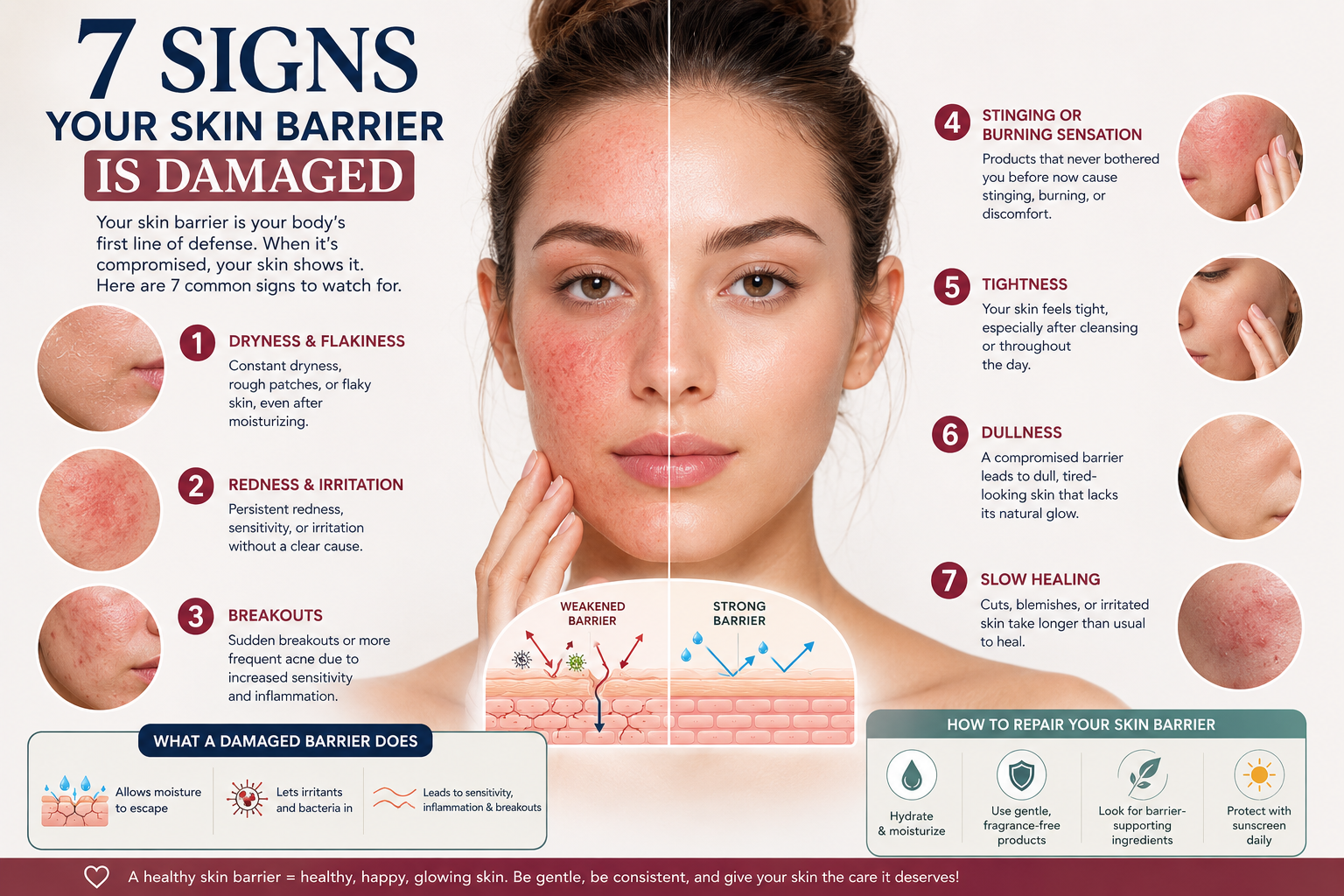
A damaged barrier is not subtle once you know the pattern. The most telling sign is that squeaky-tight feeling right after cleansing. Not clean, tight.
You will also notice persistent dryness and flaking that sticks around even after heavy creams. Redness that comes and goes, especially right after you apply skincare, is another flag. If gentle products suddenly sting or burn, your permeability has increased. Texture turns rough, skin looks dull instead of bouncy, and fine lines look sharper because dehydrated skin doesn’t reflect light well. And yes, a broken barrier can trigger more breakouts — bacteria get in easier and your oil glands overcompensate for the water you are losing.
This is different from having a dry skin type. Dry is how you were born. A damaged barrier is a temporary state that can happen to oily skin too, usually after a few weeks of overdoing it.
What Causes Skin Barrier Damage?
Most barrier damage is not about the weather. It is about routine.
Overuse of Actives and Over-Exfoliation
This is the biggest culprit right now. Layering AHA, BHA, retinol, and Vitamin C every single day strips lipids faster than your skin can remake them. Acids dissolve the mortar. Scrubs abrade it. Using three actives at once doesn’t give you faster results, it just removes the very structure that lets those actives work without burning your face.
Harsh Cleansers and Wrong pH
If your cleanser leaves your skin tight, it is too harsh. Period. Traditional sulfates and foaming cleansers formulated at pH 9 or 10 lift away your natural lipids and push your skin’s pH out of its healthy acidic range. That pH shift disrupts the enzymes that make new lipids. Combine that with very hot water, and you have a daily barrier assault.
Environmental and Internal Triggers

Environment plays a supporting role. Low humidity, long hot showers, hard water, and pollution all chip away at resilience. Internally, chronic stress raises cortisol which impairs lipid synthesis, poor sleep shortens overnight recovery, and aging naturally means you produce fewer ceramides each decade. Alone they rarely cause a full breakdown, but they make you far more vulnerable to product-induced damage.
How to Repair Your Skin Barrier: The 4-Step Protocol
You fix a compromised barrier by doing less, with better ingredients. This is not the moment for a 10-step routine.
Step 1 is to pause everything that hurts. Stop AHA, BHA, retinol, tretinoin, high-strength Vitamin C, benzoyl peroxide, and any physical scrub. Stop fragrance, essential oils, and denatured alcohol too. For the next two to four weeks, you only need three things: a gentle cleanser, a barrier-repair moisturizer, and sunscreen. You cannot rebuild a wall while someone is still hammering at it.
Step 2 is to fix your cleanse. Switch to a creamy, low or non-foaming cleanser labeled pH-balanced, ideally 5.0 to 5.5, with no sulfates and no fragrance. In the morning, many people do best with just lukewarm water. At night, use a small amount of cleanser to remove sunscreen. Keep the water lukewarm, never hot. That tight, squeaky feeling after washing should be completely gone.
Step 3 is where actual repair happens. You need to replenish the lipid layer with what your skin recognizes: ceramides NP, AP, and EOP, cholesterol, and linoleic acid-rich fatty acids. Look for those high on the ingredient list, supported by squalane, panthenol or vitamin B5, and allantoin. Apply to slightly damp skin — it helps your skin use the water more effectively.
A lot of people reach for pure petrolatum here. Petrolatum is brilliant at sealing — it can cut TEWL by up to 98% — but sealing alone is not rebuilding. Think of it as a tarp over a damaged wall. Useful, but not a replacement for new bricks and mortar. If you like it, use a thin layer over your ceramide cream on the driest patches, not as your only step.
Step 4 is to seal and protect. During the day, SPF 30 or higher is non-negotiable. A compromised barrier is far more prone to UV-triggered inflammation. If chemical filters sting right now, use a mineral formula with zinc oxide or titanium dioxide, fragrance-free. At night, your ceramide moisturizer on damp skin is enough.
Best Ingredients for Skin Barrier Repair
The ingredients that truly help are either part of your barrier naturally or they calm the inflammation that stops repair.
For rebuilding, prioritize ceramides, cholesterol, and fatty acids, especially linoleic acid. Squalane mirrors your natural sebum and reduces water loss without heaviness. Panthenol and allantoin support wound healing and comfort. Centella asiatica and its active madecassoside are excellent for redness, and colloidal oatmeal — an FDA-recognized skin protectant — is one of the best for itch and reactivity. Low-percentage niacinamide, around 2% to 5%, can boost ceramide production over time, but go easy with it at first. On a very raw barrier, even 10% niacinamide can flush.
While you are healing, put these on hold: glycolic acid, lactic acid, salicylic acid, retinoids, high-concentration L-ascorbic acid, abrasive scrubs, denatured alcohol, menthol, witch hazel, and synthetic fragrance. Even hyaluronic acid can backfire if you apply it to dry skin in a dry climate with nothing occlusive over it — it has nothing to pull water from.
How Long Does It Take to Repair a Damaged Skin Barrier?
It takes 2 to 4 weeks for most people, but it depends on how deep the damage goes.
If you over-exfoliated once or twice and feel a little tight and dry, expect 7 to 14 days. If you have persistent redness, flaking, and stinging from weeks of active overload, it takes a full skin cycle, about 2 to 4 weeks. If your barrier has been compromised for months, with chronic inflammation and dermatitis-like patches, give it 1 to 3 months of consistent care.
The thing that slows everyone down is impatience. Every time you reintroduce retinol or acids too early, you reset the clock.
A Simple Skin Barrier Repair Routine (Morning and Night)
The best repair routine is boring. That is the point.
Morning: splash with lukewarm water or use your gentle cleanser if you are oily. On damp skin, apply a generous layer of your ceramide-rich barrier moisturizer. Let it settle for a minute, then finish with a fragrance-free mineral SPF 30 or higher.
Night: cleanse once to remove sunscreen. Again on damp skin, apply your barrier moisturizer. If you have flaky patches, dab a pea-sized amount of petrolatum ointment just on those spots as a final layer.
No toners, no serums, no masks until your skin stops stinging and feels comfortable on its own.
How to Maintain a Healthy Skin Barrier Long-Term
Once your skin feels calm, hydrated, and resilient again, maintenance is about protection over correction.
Reintroduce actives one at a time. Twice a week to start, not nightly. Keep your cleanser gentle permanently — a stripping cleanser has no long-term benefit. Be mindful of water temperature, and if you live somewhere dry or run heating indoors, a humidifier in the bedroom reduces overnight water loss. Diet rich in essential fatty acids, steady sleep, and lower stress all support lipid synthesis from the inside. The healthiest skin routines are usually the simplest.
When Should You See a Dermatologist?
See a board-certified dermatologist if nothing improves after 4 to 6 weeks of a stripped-back protocol, if you have severe burning, oozing or crusting, or if you suspect you have developed atopic dermatitis, rosacea, or allergic contact dermatitis. A dermatologist can assess barrier function, measure TEWL, and rule out underlying conditions that need prescription care.
Frequently Asked Questions About Skin Barrier Repair
Can your skin barrier repair itself?
Yes, it can, but only if you stop stripping it. Your skin is constantly making new lipids. Removing irritants and giving it ceramides and cholesterol speeds up what it is already trying to do.
Does Vaseline repair your skin barrier?
Not by itself. Petrolatum does not replace ceramides or cholesterol. It forms an occlusive seal that cuts water loss and creates a protected environment so your skin can heal faster. For true repair, layer it over a ceramide moisturizer, or use a moisturizer that already contains both.
Is niacinamide good for a damaged skin barrier?
Low-strength niacinamide, around 2% to 5%, is excellent because it helps your skin make more ceramides and calms redness. On a severely damaged barrier, higher percentages can sting, so start low and introduce it after the first week.
Can a damaged skin barrier cause acne?
It can. When permeability increases, bacteria and irritants get in more easily and trigger inflammation. Your skin may also pump out more oil to compensate for dehydration, which can clog pores. A lot of people see breakouts calm down once they focus on barrier repair instead of more actives.
Read more: Korean Skincare Trends 2026: Latest K-Beauty Secrets Revealed
