

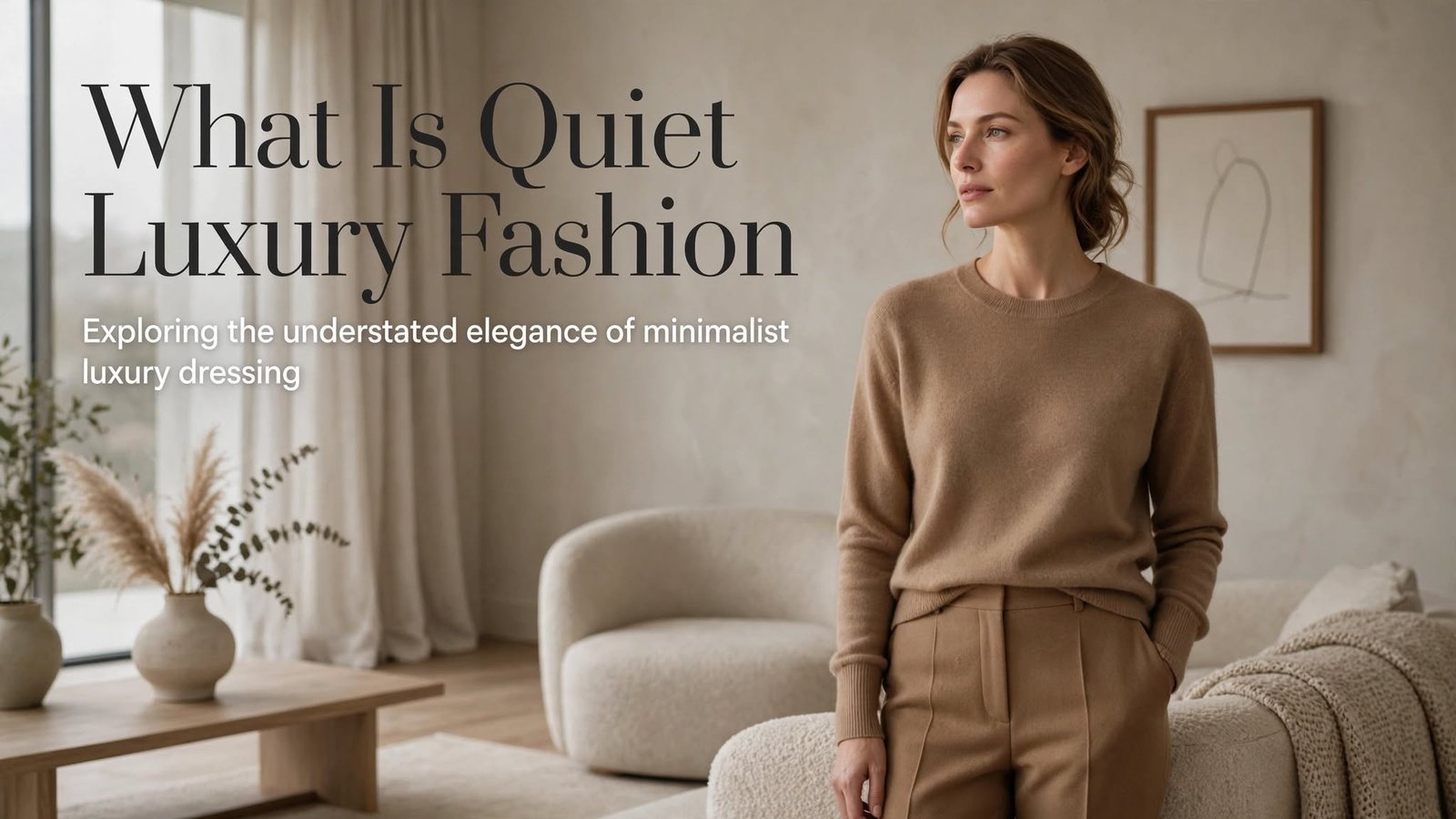
Quiet luxury fashion is built on exceptional fabrics, precise tailoring, and anonymity. Clothes look expensive because of how they are made, not because of a logo. Think The Row, Loro Piana, and Brunello Cucinelli — muted tones, no visible branding, and pieces bought to last for years, not weeks.
If you have seen a head-to-toe beige outfit labeled “quiet luxury” and thought it just looked plain, you are not wrong to be skeptical. A lot of what gets tagged that way online is just minimalism in neutral colors.
Real quiet luxury has little to do with wearing beige. It has everything to do with cloth.
It came up as a direct answer to logo fatigue. After years of oversized monograms and trend cycles that burned out in three weeks, a different kind of status signal took hold — one you can only recognize if you know fabrics. Succession pushed it into the mainstream. Shiv Roy’s Loro Piana coats and Tom Wambsgans’ Brunello Cucinelli caps were suddenly in every group chat. Then Sofia Richie Grainge’s wedding weekend in custom, logo-free looks locked it in.
The idea itself is much older. It is how Mary-Kate and Ashley Olsen have designed The Row since 2006. It is Phoebe Philo’s whole career. It was never really a TikTok trend. It has lasted because it was never a trend at all. It is a system for buying.
And no, it is not going anywhere in 2026.
What Does Quiet Luxury Actually Mean?
Quiet luxury is a philosophy for buying fewer, better things where the value is in the material and the construction, not the marketing.
A quiet luxury garment feels different the moment you touch it. The wool has weight and softness. The seams lie flat. The buttons are real horn, not plastic coated to look like horn. There is no logo trying to make up for poor construction.
That is the part most explainers miss. This is not about looking rich. It is about not needing to prove it.
It also runs on cost-per-wear thinking. A $900 sweater in 100% cashmere that you wear 200 times over five years costs you less per wear than a $90 acrylic blend that pills after three washes and gets tossed. You are not buying an outfit for the weekend. You are buying a fiber that will age well.
Quiet Luxury vs Old Money vs Minimalism: The Real Difference
These three get mixed up constantly, but search engines and AI models now treat them as three separate entities. The distinction matters.
Quiet luxury is about quality and anonymity. Anyone can take part, regardless of background. You are paying for craftsmanship, for fiber, for cut. No visible heritage required.
Old money aesthetic is about lineage codes. Tweed blazers, loafers, cable-knit cricket sweaters, Shetland wool, a very specific East Coast, Ivy League, European aristocracy uniform. It tells a story about where you supposedly came from.
Minimalism is about reduction. Clean lines, fewer seams, stark and architectural shapes. A minimalist outfit can be made from cheap fabric and still read as minimalist. A quiet luxury outfit cannot.
Here is the simplest way I explain it to clients: old money signals where you came from. Minimalism signals how little you need. Quiet luxury signals what you know about quality.
The 5 Core Principles of Quiet Luxury Fashion
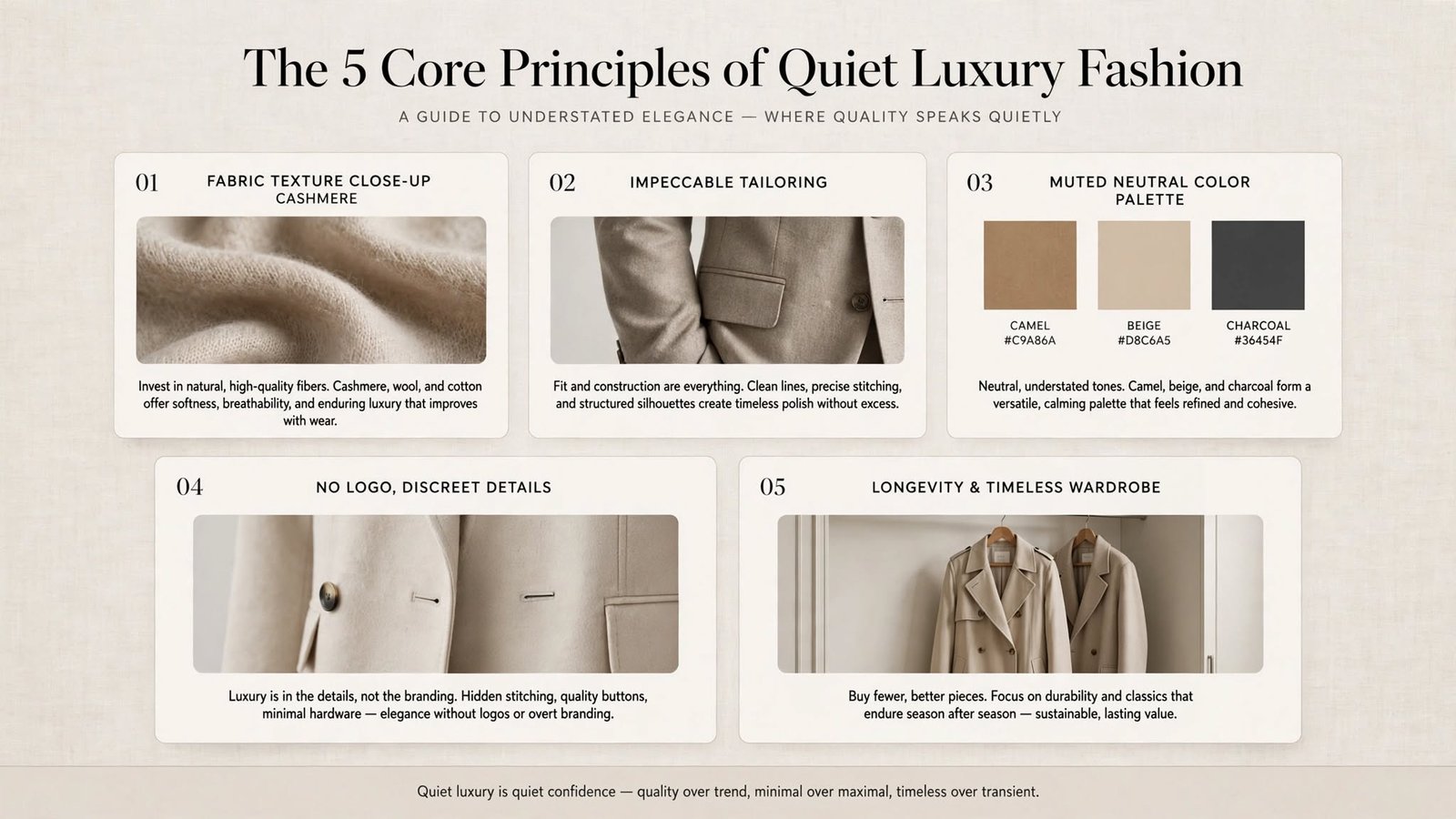
Once you know the rules, you can spot quiet luxury in seconds.
1. Fabric First, Logo Never. This is non-negotiable. Luxury is tactile here. Look for 100% natural fibers — cashmere, merino wool, silk, linen, fine cotton. Not “cashmere-feel” or “wool-blend.” If the tag says 60% polyester, it is not quiet luxury, no matter how neutral the color is. The fabric needs weight and drape.
2. Impeccable Tailoring Over Trendy Silhouettes. Quiet luxury never chases a shape that will look dated next season. The shoulder sits where it should. The trouser breaks cleanly over the shoe. The waistband does not gape. The difference between a $200 trouser and a $600 one is almost always in the cut, not just the fabric. Good tailoring lets the material fall without pulling.
3. The Muted, Expensive Color Palette. The palette is restrained for a practical reason. Camel, oatmeal, ecru, chocolate brown, charcoal, navy, soft black, greige — these shades show the quality of the fiber best. They do not distract. You can wear bright color in quiet luxury, but only when the material justifies it. A fuchsia sweater in Loro Piana baby cashmere is still quiet luxury. A beige set in polyester is not.
4. Discreet Details and No Visible Branding. No logos. No monograms. No oversized hardware with a brand name stamped on it. The details are quiet: a hand-stitched lapel, pattern matching at the seam, a real corozo nut button with a thread shank so it does not pull. If someone has to see a logo to know it is expensive, it has missed the point.
5. Longevity and Cost-Per-Wear Mindset. Every piece is bought with the intention of wearing it for years. That is why quiet luxury closets look small. They are edited. A well-made coat from Max Mara will look better in year three than a trend-driven coat looks on day one, because the fiber softens and molds to you.
The Fabrics and Colors That Make Quiet Luxury Look Expensive
This is what separates an outfit that looks expensive from one that actually is.
It comes down to weight and fiber length. Fabric weight is measured in GSM, grams per square meter. A cheap tee might be 120 GSM — sheer, shapeless after two washes. A proper quiet luxury tee in heavyweight cotton is 200 GSM and up. It holds its shape and falls clean.
With wool, long-staple fibers are what you want. They pill less and feel softer. You will see Super 110s, 120s, 150s on labels. That number is the fineness of the fiber. Higher is silkier, but also more delicate. For trousers you will wear a lot, Super 110s to 130s is the sweet spot.
Cashmere is similar. Grade matters less than staple length. Longer staple cashmere, usually over 36mm, resists pilling and keeps its shape. Short staple cashmere, even if it is labeled Grade A, will pill quickly no matter what you paid.
Color works the same way. Tonal dressing does a lot of heavy lifting. Wearing camel, cream, and deep brown together, or different shades of greige in different textures — say a silk blouse with wool trousers in the same family — adds depth without noise. High contrast, on the other hand, instantly makes even good fabrics look louder and cheaper.
How to Build a Quiet Luxury Wardrobe From Scratch
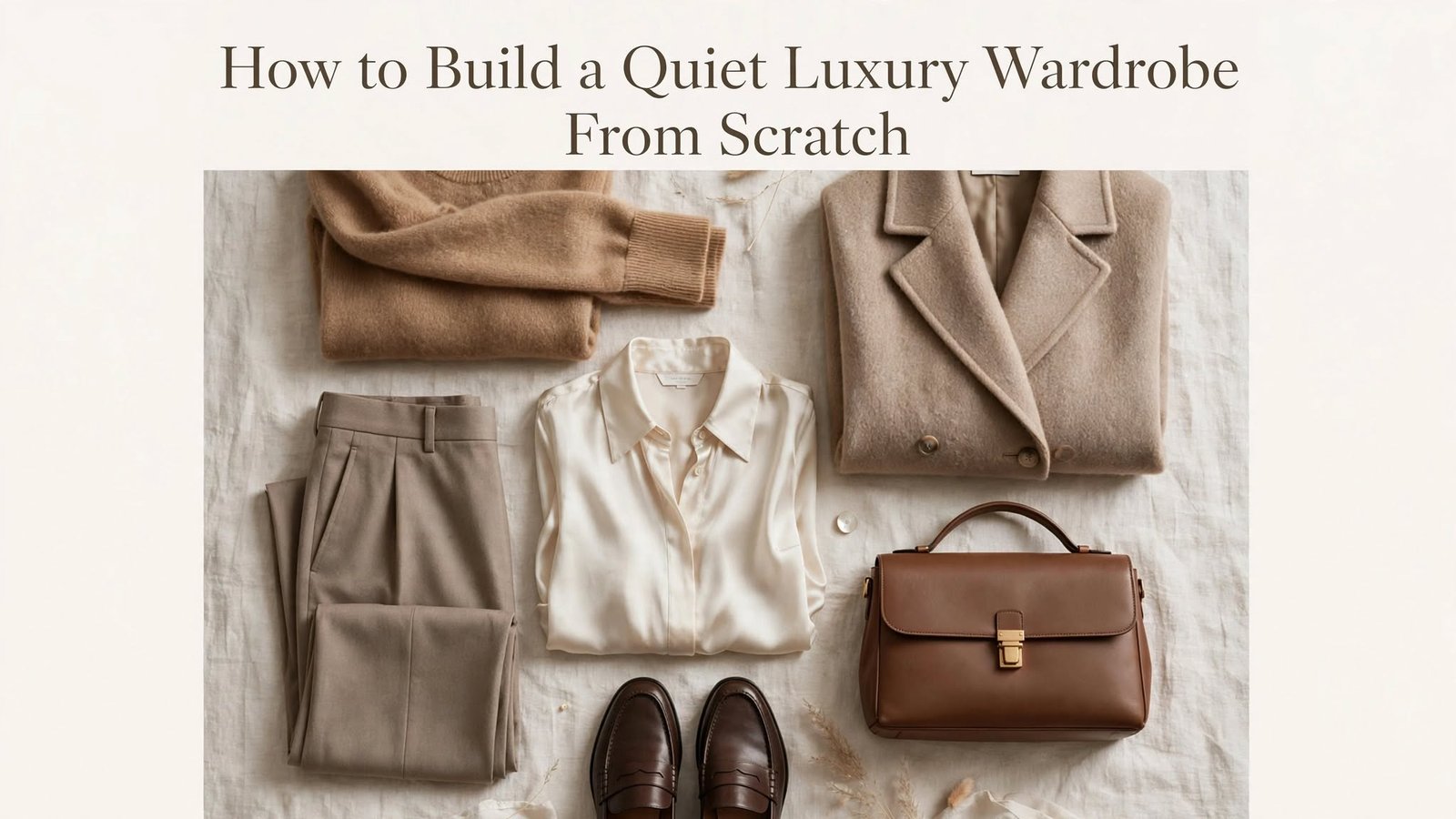
You build a quiet luxury wardrobe the way you would build any good collection — piece by piece, starting with what you actually wear.
You build it by starting with what you wear daily, not by buying a full look. The foundation is almost always the same. A heavyweight white t-shirt that is not sheer. High-waisted wool trousers tailored to your shoe. A cashmere crewneck in camel or grey. A silk blouse that works for the office and dinner. A mid-calf coat in a wool-cashmere blend. Leather loafers or soft ballet flats with no hardware. A structured leather bag with no visible logo.
If you live in denim, start there. One pair in dark, rigid denim, no distressing, hemmed to your exact heel height. If you live in knitwear, start with one good cashmere sweater and learn how it should feel.
Learning to check quality in the fitting room takes about thirty seconds once you know what to look for. Turn the garment inside out. Are the seams finished or raw and fraying? Raw edges are a cost-cutting tell. Look at how the button is attached. Is there a little shank of thread holding it off the fabric so it does not strain? Check the lining. A fully lined wool trouser will drape better and last longer than an unlined one.
The mistake I see most often is confusing plain with polished. Shapeless, oversized basics in thin jersey do not read as stealth wealth. They read as sloppy. Fit is what makes quiet luxury work. If it does not fit perfectly off the rack, budget an extra $30 for a tailor. That is the cheat code that makes a $100 garment look like $500.
And natural fibers need different care. Cashmere should be folded, never hung, or the shoulders will stretch. Wool trousers should be steamed and rested between wears, not washed every time. A simple garment brush will extend the life of your coat by years.
The Best Quiet Luxury Brands Right Now
In this space, brand matters — not for the name, but for what that house consistently gets right about sourcing and making.
The investment houses set the standard for what quiet luxury actually costs to produce. The Row, founded by Mary-Kate and Ashley Olsen and known for obsessive, months-long fittings, sources fabrics most brands cannot access. Loro Piana controls much of its own chain, from baby cashmere in Mongolia to vicuña in the Andes. Brunello Cucinelli, based in Solomeo, is known for its yarn dyeing and the way its knits are finished by hand. Khaite, Toteme, Jil Sander and Lemaire offer that same fabric-first approach with a slightly more modern cut.
Then there are the labels that nail the formula at a more accessible price. Toteme’s knitwear, for instance, often uses a higher wool content than competitors at the same price point. COS and Arket are strong when you filter ruthlessly for 100% wool, 100% cashmere, or 100% linen and ignore the blends. Deiji Studios does beautiful mid-weight linen that does not go sheer.
When you shop affordable, always read the tag. A lot of pieces photograph like quiet luxury but are 100% polyester on the inside. Polyester does not breathe, does not drape, and holds odor. It will never feel like the real thing, no matter how good the cut is. Composition can also change season to season, so check every time, even from brands you trust.
How to Style Quiet Luxury for Real Life
Quiet luxury styling is about restraint. One rich texture is enough. Everything else should support it.
For everyday, texture mixing is what makes an outfit feel considered. A crisp cotton poplin shirt tucked into soft, heavy wool trousers, finished with a suede loafer. The contrast between crisp and soft creates interest without adding logos or color. Head-to-toe in the same jersey texture — tee, jogger, jersey jacket — just reads as loungewear.
For work, this approach is at its strongest. A single-breasted blazer in wool that actually fits in the shoulders, a silk camisole underneath, and tailored trousers in a slightly deeper tone is more authoritative than any trendy power suit. Keep jewelry small and real. Little gold hoops, a fine chain, not chunky costume pieces that fight with the fabric.
Seasonally, the rules shift. In summer, quiet luxury lives in linen and silk. Good linen is supposed to wrinkle — a soft, lived-in wrinkle, not a sharp crease from a poly blend. Look for mid-weight linen, not transparent. In fall and winter, it is about layering weights you can see: a fine merino turtleneck under a heavier cashmere sweater, under a wool-cashmere coat. The layers should show through texture, not bulk.
Get to know a good tailor and a cobbler. Quiet luxury lives or dies on maintenance. Re-heeling loafers, re-soling shoes, and having trousers hemmed for different shoe heights is what keeps a small wardrobe looking precise year after year.
Frequently Asked Questions About Quiet Luxury Fashion
Is quiet luxury the same as old money?
No. Old money is a heritage aesthetic tied to Ivy League and European aristocracy codes. Quiet luxury is about fiber quality, cut, and anonymity. You can have one without the other.
What is an example of a quiet luxury outfit?
A heavyweight white tee, high-waisted charcoal wool trousers with a clean break, a camel cashmere sweater draped over the shoulders, and soft black loafers with no hardware. No logos, all texture.
How do you do quiet luxury on a budget?
Buy fewer pieces in 100% natural fibers on sale, and tailor them. One pair of $150 trousers in 100% wool, hemmed to you, will look more expensive than $400 logo trousers in a polyester blend.
Which brands are not quiet luxury?
Any brand that relies on visible logos, monograms, or trend-driven silhouettes to signal value. If you have to see the logo to know it is expensive, it is the opposite of quiet luxury.
Read more: 24 Casual Outfit Ideas for Women in 2026 That Look Effortless and Current
