

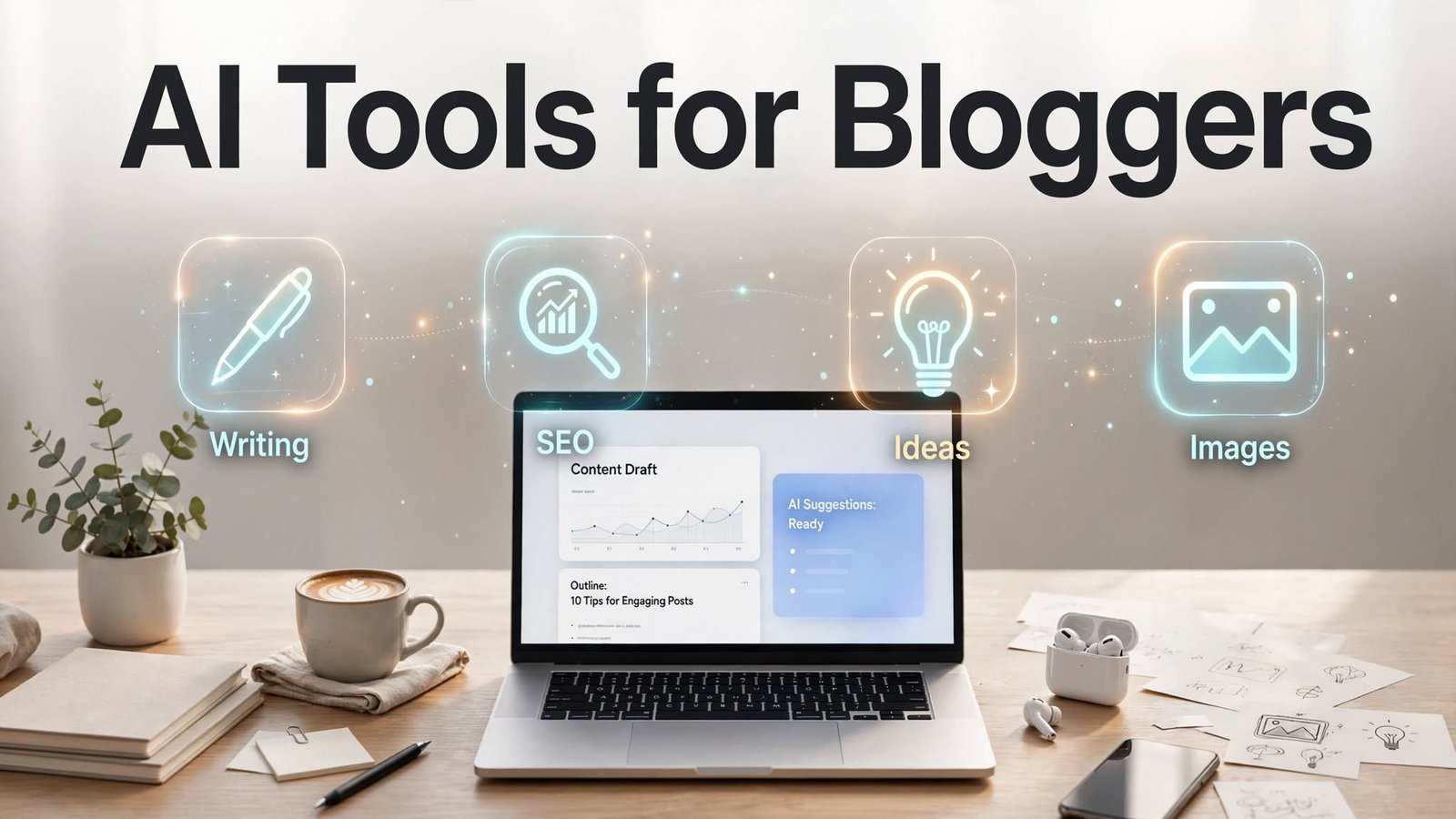
AI tools for bloggers are software built on generative AI to take over the slow, repetitive parts of blogging — coming up with topics, researching keywords, drafting posts, optimizing for SEO, and creating images. The smartest approach in 2026 isn’t finding one tool that does it all. It’s using a small, focused stack: one for research and briefs, one for long-form writing, and one for SEO optimization and editing. Used this way, with your own experience layered on top, these tools can cut your production time in half without putting you at risk with Google.
Blogging has always rewarded consistency more than occasional brilliance. The bloggers who actually make money are the ones who publish genuinely helpful content every week. For years, that pace was brutal to maintain solo. It isn’t anymore.
The right AI tools don’t replace your voice. They get the busywork out of the way so your voice can show up more often.
Why Every Blogger Needs AI Tools in 2026
Every blogger needs AI tools in 2026 because the standard for what ranks has moved. Writing well is no longer enough.
To compete, you need to understand search intent, cover every important subtopic, answer related questions, optimize for semantic search, create original visuals, and still publish consistently. Manually, that is an 8 to 12 hour job for a single post. That workload is why most people quit.
AI flips that equation. Let it handle the research, the first draft, and the optimization checks. You handle the judgment calls, the stories, and the expertise. Google has been clear on this point. They don’t care how content was produced. They care whether it is helpful. An AI-assisted post that is original, accurate, and built around real experience is exactly what they want to rank.
How We Selected and Tested These AI Tools for Bloggers
We didn’t rank these tools off their marketing pages. We tested them like a working blogger would.
We took a single competitive keyword in the blogging niche, built a content brief, wrote a 1,500-word draft, optimized it for search, and ran it through grammar and AI detection checks. Every tool was judged on four things that matter in the real world: how good the output actually is, how much time it saves, how cleanly it fits into a WordPress workflow, and whether the price makes sense for a solo creator.
Anything that produced generic filler that needed a total rewrite was cut. What is left are the tools that stayed installed after testing was over.
The Best AI Tools for Bloggers by Workflow Stage
The biggest mistake I see bloggers make is hunting for one magic tool. It does not exist. And chasing it usually ends with five subscriptions that all do the same thing.
Pros build a stack. Each tool does one job really well.
Best for Blog Topic Ideas and Content Research

This is where blogs usually stall before they start. ChatGPT and Frase solve it in two different ways.
ChatGPT is the best tool for breaking writer’s block when you give it real context. Don’t ask it for “blog post ideas about AI tools.” You will get listicles everyone else has. Try something like: “I write for beginner affiliate bloggers who feel overwhelmed by tech. Give me 10 post angles about AI tools that fix a specific frustration, not another top-10 list.” The quality of the ideas jumps immediately.
Frase is better when you want research grounded in what Google is already rewarding. It pulls the top 20 results for your keyword, extracts the questions people are asking, and shows you the subtopics your competitors missed. My own process is to start in Frase to see what must be covered, then move to ChatGPT to find an angle no one else is using.
Best for Keyword Research and SEO Content Briefs
Keyword research today is about intent, not just volume. NeuronWriter and Frase were built for that.
Old keyword tools give you a list of keywords. These give you a brief. They look at the SERP and tell you what sections your article needs, what questions to answer under your H2s, and which related terms signal topical depth to Google. For a topic like AI tools for bloggers, a good brief will tell you to also address AI detectors and Google’s stance on AI content, because the pages already ranking all cover it. Miss that, and you publish something that never had a chance.
If you want organic traffic, don’t start writing without a brief. It is the difference between guessing what people want and knowing what search data says they need.
Best for Writing Long-Form Blog Posts Faster
This is where most people look first, and where most tools disappoint. Jasper, Koala AI, and Writesonic are the most consistent for long-form work right now.
Jasper holds up well because it can learn your voice. Feed it a few of your best posts and it starts to match your cadence and word choice, which cuts editing time. It also stays coherent across a 2,000-word draft, which a lot of tools still struggle with.
Koala AI was built specifically for SEO bloggers. It connects to live search results and can produce a solid, reasonably optimized first draft in one go, including an intro that doesn’t sound like every other AI intro out there. The direct WordPress integration seems minor until you use it and realize how much copy-pasting it saves.
The rule here is simple. Never publish the first draft. Use AI to get you to 70%. Let it build the structure and handle the straightforward explanations. You bring the final 30% that AI cannot fake — a personal mistake, a screenshot from your own Search Console, a dissenting opinion.
Best for Rewriting, Paraphrasing, and Humanizing AI Content
Unedited AI writing has a tell. It is too smooth, too balanced, too predictable. Readers can feel it, even if they cannot name it. Detectors flag it instantly.
Originality.ai is useful here not just as a detector, but for breaking those predictable patterns. QuillBot is better for surgical work, like rephrasing a dense technical paragraph into something a beginner can understand without losing the meaning.
Don’t use these tools to spin other people’s work. Use them on your own draft to fix the rhythm. One of the fastest ways to sound human is to read your draft out loud and cut any sentence over 25 words. Humans naturally mix short, punchy lines with longer ones. AI tends to write everything at the same length.
Best for On-Page SEO Optimization and Ranking
Writing the post is only half the work. Getting it to rank is the other half. Surfer SEO is still the benchmark for on-page.
Surfer scores your content against what is already ranking — NLP terms, coverage, heading structure, word count. It is not about keyword stuffing. It is about making sure you have fully covered the topic. If Surfer suggests you mention “content brief” and “E-E-A-T” several times in an article about AI blogging tools, it is because Google sees those concepts as closely tied to the main topic.
If you live in WordPress and want something faster, Rank Math’s Content AI does a decent job inside the editor itself. It is not as deep as Surfer, but for daily posts it is quick and good enough.
A quick troubleshooting note. If your post scores 90+ in Surfer and still does not rank, the issue is rarely on-page. It is usually topical authority or lack of internal links and backlinks. Do not keep rewriting a well-optimized draft trying to hit 100.
Best for Editing, Grammar, and Readability
Grammarly remains the best editing tool for bloggers, but not for the reason most people think. The value is not in catching typos. It is in the clarity and readability suggestions.
Most bloggers write at a level that is too complex for mobile readers. Grammarly will flag long paragraphs, passive voice, and sentences that make the reader work too hard. You are not dumbing your work down. You are making it effortless to read. Easier posts keep people on the page longer, and that sends positive signals to Google.
Best for AI Blog Images and Visuals

You can’t rely on stock photos anymore. They are expensive and look like stock photos. Canva’s Magic Studio has become the default for most bloggers because you can generate a featured image, in-post illustrations, and Pinterest assets from one prompt, all in your brand colors.
Midjourney creates more beautiful images, but Canva wins on workflow. The best use of AI images is not decoration. It is explanation. A simple custom graphic that shows your AI blogging workflow is more valuable than a generic illustration of a robot at a laptop.
Free vs. Paid AI Tools for Bloggers: What Should You Actually Pay For?
You do not need to spend $200 a month to get started.
For a new blogger, a free stack is more than enough. Use ChatGPT for ideas and outlines, Google’s People Also Ask and Keyword Planner for research, the free version of Grammarly for editing, and Canva free for images. At this stage, you should be investing time, not money. Learn to publish consistently first.
You should start paying when consistency is no longer the problem. Once you have published every week for three months, the ROI of paid tools becomes obvious. A tool like Surfer or Frase at $30 to $50 a month pays for itself if it helps one post move into the top five and earn affiliate commissions. A writing tool like Jasper or Koala pays for itself if it saves you four hours per post.
The mistake to avoid is buying five tools that all write. Pay for coverage across your workflow — one for research, one for writing, one for optimization.
Can You Use AI Tools for Blogging Without Getting Penalized by Google?
Google will not penalize you for using AI tools, as long as what you publish is genuinely helpful.
That is straight from Google’s guidance on AI-generated content. They reward helpful, reliable, people-first content, no matter how it was made. What they do penalize under their spam policies is scaled content abuse — publishing hundreds of thin AI posts with no human review, no original insight, and no real experience behind them.
To stay on the safe side, stick to three rules. First, always add your own experience. E-E-A-T is not just an acronym. It is what Google looks for. Share a result you got, a tool you tested yourself, or a lesson you learned the hard way. Second, fact-check everything AI gives you. Tool prices, features, and stats change constantly, and AI will confidently make them up. You are responsible for accuracy. Third, edit for helpfulness, not just for grammar. After reading your post, could someone actually take action? If not, it is not ready.
Bloggers don’t get penalized for using AI. They get penalized for publishing without adding value.
How to Build a Human-First Blogging Workflow With AI Tools
The best workflow is not fully automated. It is human-led with AI doing the heavy lifting.
Start with research, not writing. Use a brief tool to understand what search intent looks like for your keyword and what questions you have to answer. Then use ChatGPT to find a personal angle your competitors missed.
Next, build the outline. Have AI draft it from the brief, then reorder it based on what a beginner would actually need to know first. AI is logical but it doesn’t have empathy for a confused reader.
Then draft. Let your writing tool turn that outline into a first draft. Give it your voice guidelines and tell it to keep paragraphs short.
Now the critical part — the human layer. Go back through the draft and replace generic statements with specific experience. Instead of “AI tools can help with SEO,” write “When I started building briefs in Surfer instead of guessing, my average time to hit the top 10 went from 68 days to 34 days.” That one line carries more E-E-A-T than any optimization score.
Finally, optimize and polish. Run it through your SEO tool for coverage, then through Grammarly for readability. Add your images and internal links last.
Two prompts I use constantly: For outlines — “Create a detailed outline for for. Include what top-ranking articles miss and add a section on common mistakes.” For humanizing — “Rewrite this paragraph like an experienced blogger explaining it to a friend. Use contractions, mix short and long sentences, and add one short sentence for emphasis.”[keyword][audience]
Final Verdict: Which AI Tools Stack Should You Choose?
There is no single best AI tool for bloggers. There is only the right stack for where you are.
If you are new, keep it lean. ChatGPT for ideation, Frase or NeuronWriter for briefs, Grammarly and Canva for polishing. Your goal is consistency, not complexity.
If you are focused on SEO and growing organic traffic, invest where it moves rankings. Surfer SEO or Frase for content intelligence, Koala AI or Jasper for drafting, and Originality.ai for quality control. This stack is built to rank.
If you are an affiliate blogger trying to scale to multiple posts a week, you need speed that doesn’t sacrifice trust. Koala AI for WordPress-ready drafts, Surfer for optimization, and a strict editing pass where you add your own testing of every product you recommend. In affiliate content, your lived experience is what actually converts.
Start with one tool per stage. The goal was never to collect tools. It was to publish more helpful work, more often, without losing what makes it yours.
FAQs
1. What is the best AI tool for bloggers?
There is no single best tool. The best approach is a small stack. Most pro bloggers use ChatGPT for ideas and outlines, Koala AI or Jasper for long-form writing, and Surfer SEO or Frase for SEO optimization. This combination covers research, writing, and ranking.
2. Can I use AI tools to write my entire blog?
You can use AI to write your first draft, but you should never publish it without human editing. Add your own experience, examples, fact-check all information, and rewrite it in your own voice. Google rewards helpful content with E-E-A-T, not fully automated content.
3. Will Google penalize my blog for using AI content?
No. Google does not penalize content just because AI was used. According to Google Search Central, they reward helpful, people-first content no matter how it is created. You will only get penalized if you publish low-quality, spammy content at scale with no human review or original value.
4. What are the best free AI tools for beginner bloggers?
For beginners, the best free stack is ChatGPT for topic ideas and outlines, Google Keyword Planner for keyword research, Grammarly free version for grammar and readability, and Canva free for blog images. This is enough to start publishing consistently before paying for any tool.
5. How do I make AI-written content sound human?
Read your draft out loud and break long sentences. Use contractions like “you’re” and “don’t”, mix short and long sentences, and add personal stories or results. For example, instead of writing “AI tools help with SEO,” write “When I started using Surfer SEO, my posts started ranking in 34 days instead of 68 days.”
6. Which AI tool is best for SEO blogging and ranking on Google?
Surfer SEO and Frase are the best for SEO blogging. They analyze top-ranking pages and tell you which topics to cover, which questions to answer, and which semantic keywords to include. They give you a content score that helps you fully cover the topic before you publish.
Read more: Best Remote Business Models for Entrepreneurs in 2026
