

![15 Profitable Digital Business Ideas to Start in 2026 [Low Investment Guide]](https://lifehelpertips.com/wp-content/uploads/2026/09/15-Profitable-Digital-Business-Ideas-to-Start-in-2026.png "15 Profitable Digital Business Ideas to Start in 2026 [Low Investment Guide]")
The best digital business ideas in 2026 are the ones that turn a skill or an audience into an asset you own. If you want low investment and a fast start, focus on digital products, paid newsletters, AI automation services, niche affiliate sites, and micro-SaaS built with no-code tools. They need almost no capital to launch, they can be run from anywhere, and they scale without inventory.
What Is a Digital Business and How Does It Actually Make Money?
A digital business is any business where the product, the marketing, and the delivery happen online. You don’t need a shop or a warehouse. Your inventory is usually intangible – a template, a piece of software, a video, or access to your expertise.
The money comes from four models that actually hold up. First is digital products. You build something once, like a Notion system or a set of pitch deck templates, and sell it repeatedly. Second is subscriptions, where people pay every month for a newsletter, a community, or software access. Third is services, where you sell a specific digital outcome like SEO growth or automated lead follow-up. And fourth is e-commerce without inventory, like print on demand. The strongest businesses right now don’t pick just one. They combine a service to get cash flow early, then layer in a product or subscription for leverage.
How to Choose the Right Digital Business Idea For You
The right idea isn’t the most hyped one on Twitter. It’s the one you will actually stick with.
Most people pick backwards. They look for the most profitable idea instead of the most fitting one. A better filter is constraints. How much time do you really have? If it’s two hours after your day job, a client-heavy agency will burn you out. A product like templates or a weekly newsletter fits that schedule far better. If you can work full-time on this, services will get you to your first dollar much faster than content.
Then check your budget. Some ideas truly start at zero if you have a laptop and internet – freelance writing, UGC videos, selling templates you already use. Others need a small tool stack, usually $100 to $500 for a domain, hosting, and an email tool.
Finally, be honest about your edge. If you can write clearly, a newsletter or an affiliate site gives you leverage. If you are good at teaching or have gotten a result for yourself, coaching and courses pay more per hour than almost anything else. If you like systems and get nerdy about tools, AI automation and micro-SaaS have far less competition and far higher pricing power.
Best Digital Business Ideas for Beginners in 2026
1. Selling Digital Products and Templates
This is the cleanest entry point. You take a problem you’ve already solved for yourself and package the solution into a file someone else can buy.
Think budget trackers in Notion, resume templates for UX designers, financial models for Amazon sellers, or Canva pitch decks for early-stage founders. Why it works now is simple. People don’t want another tutorial on how to build the system. They want the finished system. Platforms like Gumroad, Shopify, and even Etsy have made buying a digital file as easy as buying a coffee.
The trap here is going too broad. A generic content calendar doesn’t sell. A content calendar built specifically for solo real estate agents trying to post on Instagram three times a week does. Specificity is what turns a template into a tool.
2. Paid Newsletter and Community Business
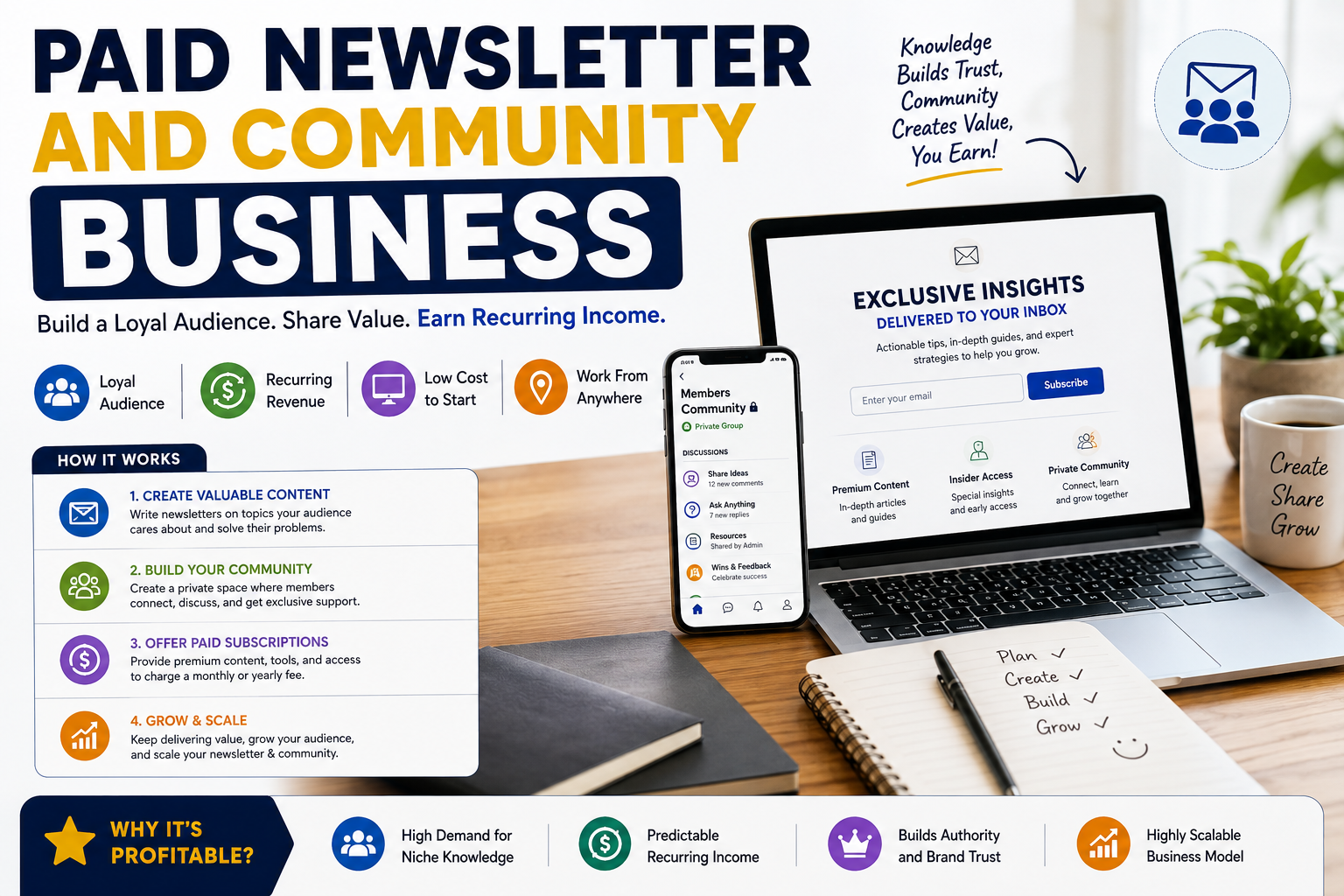
A paid newsletter isn’t about news. It’s about saving your reader time. You do the reading, testing, and filtering, and they pay for the shortcut.
Beehiiv, Substack, and Circle have removed all the technical friction. You can start free, publish for 60 to 90 days to earn trust, then add a premium tier at $10 to $25 a month. The ones that grow fastest are obsessed with one narrow, valuable niche. Not AI in general. AI workflows for freelance recruiters. Not marketing. Teardowns of onboarding emails for mobile apps. When you go that narrow, your readers feel like you built it just for them, and communities work the same way. People pay to be in a room where everyone is solving the same problem.
3. Online Coaching and Consulting
If you have achieved a specific outcome for yourself or for a client, you can coach others to do the same. Coaching is not a course. It’s live, it’s interactive, and it’s tied to an outcome.
It’s also one of the highest margin ways to start because your upfront cost is mostly your time. One Calendly link and three discovery calls are enough to validate an offer. Where most beginners get stuck is trying to coach on something vague like business or mindset. The market doesn’t buy vague. It buys a clear before and after. Helping Shopify jewelry brands lift conversion from 1.8% to 2.8% in 30 days is tangible. Helping people grow their business is not.
4. Creating and Selling Online Courses
Courses still sell incredibly well, but buyers have become ruthless about length. No one wants a 40-hour mega-course sitting in their account.
What people will pay for in 2026 is a short, focused transformation. Not a course about Notion. A course about building a client portal in Notion so you get paid faster and stop chasing approvals in email. Teachable, Skool, and Gumroad handle hosting and payments, so you can focus on teaching. Keep lessons under eight minutes, record with Loom, and always include the actual templates you use. Completion, not production value, is what drives refunds down and testimonials up.
5. Print on Demand Business
Print on demand lets you sell physical products like t-shirts, hoodies, and mugs without ever touching inventory. When a customer orders, your print partner makes it and ships it.
That removes the two reasons most e-commerce stores die early – cash tied up in stock and the nightmare of fulfillment. With Shopify plus Printful or Printify, the whole flow is automated. The creative edge now isn’t just having cool art. It’s building a store around a single identity. Stores for ER nurses, for first-time dads, for women who lift – those outperform generic stores with funny quotes because the buyer feels seen.
Most Profitable Digital Business Ideas With Low Investment
6. AI Automation Agency
This is one of the most profitable service models right now. You help small businesses stop doing repetitive work manually.
You’re not building fancy AI from scratch. You’re connecting the tools they already pay for. A typical build looks like this – a lead comes in from Facebook Ads, gets added to Google Sheets, receives a WhatsApp follow-up, a draft proposal is created in Gmail, and the owner gets a Slack notification. You can build that with Zapier, Make, or Lindy in an afternoon.
Businesses will happily pay $800 to $2500 a month for that because it replaces a part-time VA. The trick is to stop selling automation as a concept. Productize it. Pick one industry, like real estate agencies or dental clinics, and sell the same three automations over and over. Sell hours saved, not tools used.
7. Faceless Content Business
You don’t need to be on camera to build a valuable content asset. Faceless YouTube channels, TikTok pages, and Instagram theme pages make money through ads, brand deals, and their own digital products.
The playbook is consistent. Choose a niche with high watch time – personal finance breakdowns, history stories, AI news summaries, or relaxing music with visuals. Write a tight script, use a voiceover from ElevenLabs, and edit with stock footage. What kills most channels isn’t editing quality. It’s retention. The first three seconds and the way you structure a story matter more than anything else. Short videos that deliver one clear insight in under 60 seconds are winning right now.
8. Affiliate Marketing Website
Affiliate marketing still works, but Google has raised the bar. Thin sites that just rewrite Amazon descriptions don’t rank anymore.
What ranks is real experience. A site built around products you actually use and test. If you write about podcasting microphones, show your own audio tests, photos of your desk setup, and what you didn’t like. That first-hand detail is exactly what Google’s EEAT guidelines are looking for. You earn through Amazon Associates, Impact, and direct brand partnerships. And unlike freelance work, the content keeps earning while you sleep, and the site itself becomes a sellable asset.
9. User-Generated Content Creator Agency
Brands have quietly moved a huge chunk of ad spend away from polished commercials to lo-fi, phone-shot videos that feel native on TikTok and Instagram Reels. That’s UGC.
As a creator, you get paid to film those videos. You don’t even need to post them on your own account. Most beginners can charge $150 to $400 per video with just a phone and good window light. Once you have five to ten brand results, you turn it into a small agency that delivers 10 to 15 videos a month on retainer. Brands don’t pay for pretty footage. They pay for hooks that stop the scroll and angles that convert.
10. Freelance Service Productization
Freelancing becomes a real business when you stop selling time. Productization is how you do that.
Instead of offering custom SEO help, you offer a fixed package – a technical audit with 15 Loom videos and a prioritized fix list delivered in five days for $600. Instead of I write content, you offer 4 newsletter issues per month with research and subject lines included for $1200. Fixed scope, fixed price, fixed timeline. It removes negotiation and makes you easy to buy. For most people, this is the most reliable path from zero to $5k a month without raising money. Start general to get reps, then niche down to I do X for Y as fast as you can.
AI-Powered Digital Business Ideas for 2026
AI hasn’t just created new business models. It has made technical businesses accessible to non-technical people.
11. Micro-SaaS with No-Code Tools
Micro-SaaS is a small software tool that solves one painful problem for a small audience and charges $19 to $99 a month. In the past you needed a developer. Now you can build it with Bubble, Softr, Glide, and Supabase.
The winners right now are boring and specific. A client portal for social media managers. A simple compliance checklist for Airbnb hosts. A resume parser for recruiters in one industry. The mistake is building first and hunting for users later. Flip it. Build for an audience you already have access to. If you hang out in a Facebook group of 10,000 realtors, build something that saves them two hours a week. Distribution beats product in the early days.
12. AI Prompt Packs and Custom GPTs Store
Companies know they should be using AI, but they don’t have time to figure out prompt engineering. They will pay for ready-to-use prompts and custom GPTs that do a real job.
That could be 100 prompts for writing Amazon listings that actually convert, or a custom GPT trained on their HR handbook to answer employee questions. You can sell these on Gumroad or Shopify. A prompt by itself is hard to value. A prompt bundled with a short video showing the before and after result becomes a product people understand.
13. No-Code Website and Funnel Building Service
Every business needs a website, but most businesses are embarrassed by theirs. With Webflow, Framer, and Carrd, you can launch something that looks premium in days.
The real opportunity isn’t just design. It’s building a page that converts. A single landing page with a booking system for a local service business can easily be $1000 to $3000 upfront, plus $99 a month for hosting and updates. You don’t need a big resume to start. Build two concept sites for your ideal clients, put them in your portfolio, and use them to land your first paying project.
Digital Business Ideas You Can Start With No Money
14. Freelancing to Agency Model
If your budget is zero, start with a skill you already have. Writing, short-form editing, thumbnail design, customer support, lead research – all of these have daily demand on Upwork, Fiverr, and LinkedIn.
The jump from freelancer to agency owner is simple in theory. You get more work than you can handle, you raise your prices, and you bring in another freelancer to help deliver. Your profit is the margin in between. A lot of seven-figure agencies started exactly like this. The fastest way to get stuck is staying a generalist forever. The moment you can say I do this specific thing for this specific type of business, you stop competing on price.
15. Digital Product Reselling and Curation
You don’t have to create everything from scratch. Many creators offer white-label rights to templates, stock footage, and educational kits that you can rebrand and sell.
Curation is also a business model in itself. A well-maintained library of the best free tools for a specific profession – say, for solo lawyers or for Etsy sellers – can be monetized through affiliate links and sponsorships. It requires taste and consistency more than capital.
How to Validate Your Digital Business Idea in 7 Days
This is where most beginners waste months. They build first and ask for feedback later.
You can test an idea in a week without writing a line of code. Spend the first two days talking to ten people in your target market. Don’t pitch your idea. Ask about how they currently solve the problem and where it breaks. If three people describe the same frustration in their own words, you have a real signal.
On day three and four, put up a simple page that explains the outcome you provide and who it’s for. Add a buy button or a waitlist form. A Notion page with a Tally form is more than enough.
On day five through seven, send 15 to 20 of the right people to that page from Reddit, LinkedIn groups, or Slack communities where your audience hangs out. If two people pay or leave a detailed email saying they want this now, you have enough validation to build version one. If you hear nothing, it’s usually not the idea that’s off. It’s the message. Make the promise narrower. Instead of I help businesses grow, try I help Shopify jewelry stores recover abandoned carts with a 3-email sequence in 48 hours.
How Much Does It Really Cost to Start a Digital Business?
You can start for $0 if you sell your time or knowledge you already have. Your laptop and internet are the only real requirements.
If you want to look professional from day one, budget $100 to $500 for the first three months. That usually covers a domain, hosting, an email tool, and one premium AI subscription. A newsletter on Substack can be free until you want custom branding. A print on demand store is around $29 a month for Shopify plus the cost of a few sample orders to check quality.
You don’t need to form an LLC on day one to take payments. You can operate as a sole proprietor and use Stripe or PayPal. Once you’re consistently clearing $1000 a month, that’s a good time to talk to an accountant about forming an entity for liability and tax purposes. Don’t let paperwork become a reason not to launch.
Which Digital Business Idea Should You Start? – Final Recommendation
If you need cash flow in the next 30 days, start with a productized service or UGC creation. You’ll learn sales and delivery faster than with any other model.
If you want to build an asset that pays you while you sleep, start with digital products or a paid newsletter. The first 90 days are slower, but after six months the compounding is hard to beat.
If you are technical or love building systems, go for AI automation and micro-SaaS. They command higher monthly retainers, have less price sensitivity, and are much easier to sell later.
There is no perfect idea. There is only the idea you will stick with long enough to get good at. Pick one, give it seven days to validate, then give it 90 days of focused execution before you even think about switching.
Read more: Digital Minimalism for BeginnersHow to Reclaim Your Focus Without Quitting Tech
