

Educational technology, commonly called EdTech, is the practice of using hardware, software, and learning theory to improve teaching and learning. Its purpose is not to replace teachers but to help them personalize instruction, expand access, and use data to make better decisions.
According to UNESCO’s 2023 Global Education Monitoring Report on Technology in Education, technology can improve learning outcomes when it is built to serve pedagogy, not the other way around. That is the entire field in one sentence.
For years, EdTech meant a projector cart or a computer lab you booked on Thursdays. Today it includes your learning management system, an AI tutor that adapts to a student’s misconceptions, and the data infrastructure that ties it all together. The tools have changed. The core work has not: help people learn more effectively.
What is Educational Technology?
Educational technology is both a field of study and a daily practice. As a field, it draws on learning science, cognitive psychology, and design to understand how people learn. As a practice, it designs, implements, and evaluates learning environments where technology plays a supporting role.
It is bigger than a collection of apps. A school can buy a hundred licenses and still not be doing educational technology well if there is no intentional design behind their use.
This is where the confusion with instructional technology comes up. In practice, people use the terms interchangeably, which is fine for most conversations. If you want precision, instructional technology is narrower. It focuses on the design of instruction — objectives, sequencing, assessments.
Educational technology is the broader ecosystem. It includes instructional design, but it also covers the infrastructure, policies, procurement, data governance, and professional learning that allow instruction to work at scale. One is about building a great lesson. The other is about building a system where great lessons happen reliably for every learner.
What is the Main Purpose of Educational Technology?
The main purpose of educational technology is to improve learning outcomes by making learning more personalized, more equitable, and more efficient for teachers.
Personalization is the most immediate shift. In our work with three mid-sized districts, the biggest early win was never the tool itself. It was that teachers could finally act on differentiation without adding five hours of prep. An adaptive platform handles the first pass — extra practice for one student, acceleration for another — so the teacher can do the work that requires a human: discussion, coaching, mentoring.
The second purpose is equity of access. The U.S. Department of Education’s National Education Technology Plan frames this explicitly: technology should close opportunity gaps. That can mean a student in a rural district accessing an AP course their school can’t staff, or a learner using built-in text-to-speech and translation to access grade-level content. When accessibility is designed in, not bolted on, it removes barriers unrelated to ability.
The third purpose is better information. Good EdTech makes invisible learning processes visible. Instead of discovering on the midterm that half the class is lost, you see on Tuesday that students rewatched the same segment three times or that one distractor is pulling 40% of responses. That turns assessment from a post-mortem into a formative tool you can act on that week.
What Are the 3 Main Types of Educational Technology?
Categorizing by brand name is how you end up with a random list of logos. Categorizing by function is how you actually make decisions.
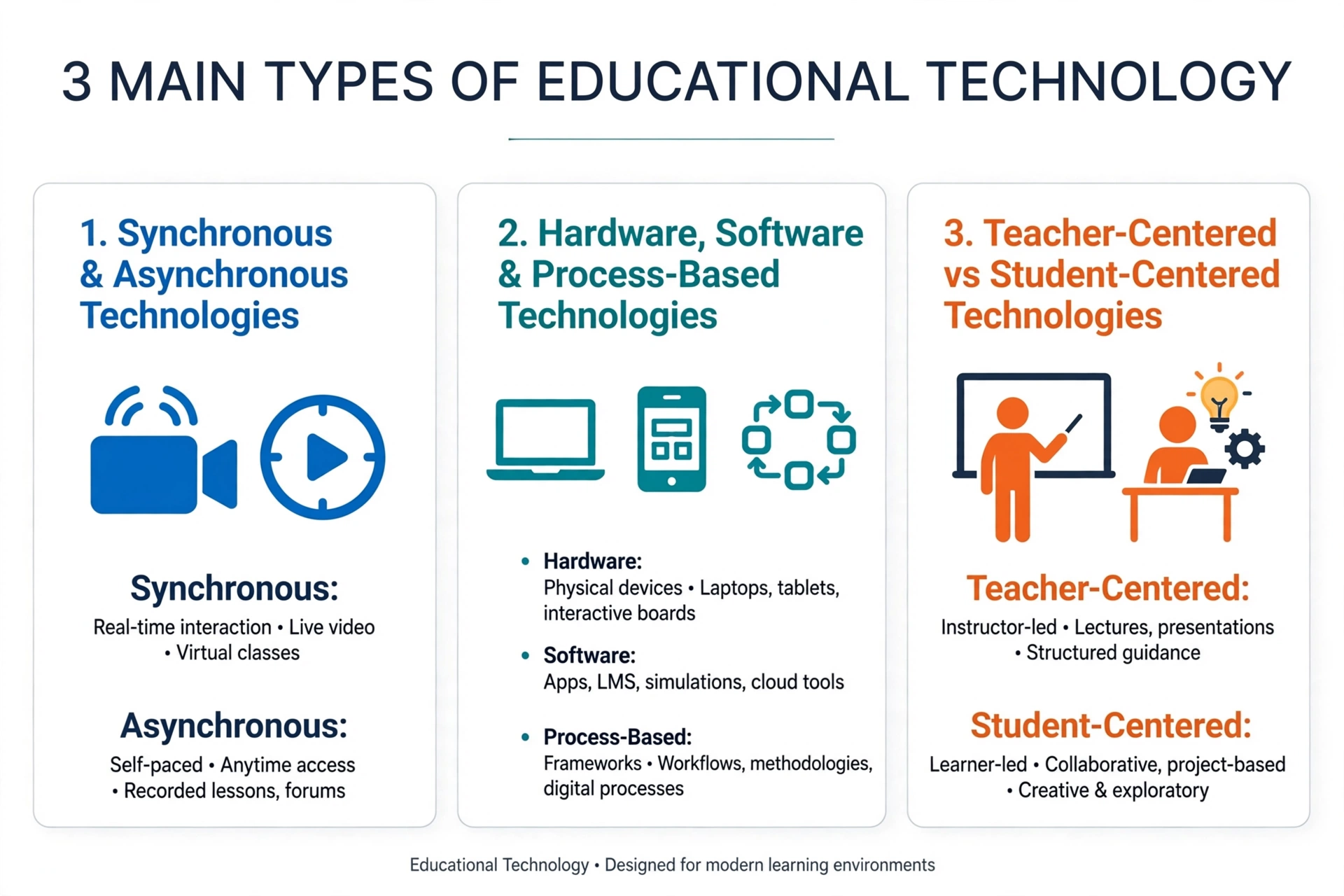
1. Synchronous and Asynchronous Learning Technologies
This is about time. Synchronous requires people to be present together — live video class, real-time chat, co-editing on a shared whiteboard. It builds community and is powerful for debate and collaborative problem-solving.
Asynchronous decouples learning from a shared schedule — recorded explanations, discussion boards, self-paced modules in Canvas or Moodle, feedback left overnight. It creates time to think, which often produces deeper responses. The strongest programs I’ve seen don’t pick one. They use asynchronous for first exposure and practice, and protect synchronous time for active application.
2. Hardware, Software, and Process-Based Technologies
Hardware is the physical layer: Chromebooks, interactive flat panels, VR headsets. Software is what runs on it: the LMS, the reading fluency tool, the plagiarism check, the AI assistant.
The overlooked layer is process. These aren’t devices at all. They are frameworks enabled by technology. The flipped classroom is a process. The SAMR Model — which ISTE references for thinking about technology integration from Substitution to Redefinition — is a process. Learning analytics is a process. Districts that invest in hardware and software without process are the ones where tech becomes an expensive projector.
3. Teacher-Centered vs. Student-Centered Technologies
Teacher-centered tools make teaching more sustainable: gradebooks, curriculum mapping, attendance, question banks. They give time back.
Student-centered tools put creation in students’ hands: students producing explainer videos, building portfolios, coding simulations, using generative AI to critique their own thesis statements. That move from consuming content to producing artifacts is where the research consistently shows stronger retention.
Essential Examples of Educational Technology in the Modern Classroom
Instead of a list of 20 apps that will be outdated by next fall, think in terms of jobs to be done.
Learning Management Systems remain the backbone. Canvas, Moodle, and Schoology are no longer file repositories. They sequence learning, manage communication and grading, and give students one clear place to understand what to do next and why. If your LMS is messy, everything else feels messy.
Adaptive and AI-powered platforms are the next layer. ALEKS for math or modern language platforms do more than serve more questions. They build a model of what a student understands and adjust. Quick mastery moves a student forward. A persistent misconception triggers a different instructional move. That is fundamentally different from a static worksheet.
Assessment and feedback tools have matured beyond clickers. Now you can get useful instant feedback on short writing, surface patterns in math errors without grading 120 problems by hand, and return feedback while students still have time to use it.
Collaboration and virtual classroom tools have settled into their real value. The best use today is not livestreaming a lecture. It is enabling collaboration that could not happen otherwise — students in different states co-analyzing a dataset, or anonymous peer review that actually leads to revision because it feels safe.
Gamification and immersive technologies like AR/VR are finally past novelty. Effective gamification is not about points. It is about clear goals, immediate feedback, and incremental challenge. VR is proving most useful where the real alternative is too expensive, dangerous, or impossible — a chemistry lab you can fail in safely, a welding simulation, a walk through ancient Rome.
What Are the Key Benefits of Educational Technology?
The core benefit is personalization at a scale a single teacher cannot achieve alone, without burning out.
For students, it is agency. Choice in how to demonstrate understanding — an essay, a podcast, a prototype — increases persistence. Immediate hints when stuck keep momentum. For students with disabilities, features like text-to-speech, adjustable reading levels, captions, and translation are now native to most platforms. That shifts accessibility from an afterthought to a default, which ISTE’s standards explicitly call for.
For teachers, it is time and insight. Automating attendance, low-level grading, and copying does not sound transformative until you get those hours back each week. More importantly, you get evidence. You can see where students paused, what they rewatched, which misconception persists. You can teach from data without teaching to a dashboard.
For institutions, it is reach and consistency. A district can ensure every student has access to the same high-quality core materials regardless of zip code. A university can serve learners who cannot relocate. It is not automatically cheaper. It is more scalable when implemented with a clear instructional purpose.
What Are the Real Challenges of Educational Technology?
Most EdTech failures I have audited were not technical. They were implementation failures.
First, the digital divide. If your plan assumes reliable high-speed internet and a new device at home, you will widen inequities. Any initiative that requires significant at-home bandwidth must address connectivity and device access first, not as a footnote.
Second, privacy and governance. Personalization requires data, and schools are stewards of that data. Under FERPA in the U.S. and GDPR in Europe, you have legal obligations that do not disappear because a tool is free. A common mistake is teachers adopting consumer tools without district review. A lightweight procurement process that includes a privacy and security review is not bureaucracy. It is protection.
Third, professional learning. Handing a teacher an interactive panel with a 30-minute demo and expecting transformation is unrealistic. Effective professional development is ongoing, subject-specific, and focused on lesson redesign, not button-clicking. Without it, even excellent tools become expensive presentation screens.
Fourth, platform fatigue. When a district adopts twelve disconnected tools, the cognitive load falls on teachers and students. They spend more time managing logins than learning. The strongest implementations I have seen are intentionally restrained. They choose a small core of interoperable tools that work together and go deep.
How to Choose and Implement Educational Technology Effectively
Effective implementation starts with a learning problem, not a product demo.
Step 1: Start with Learning Goals, Not Tools
Name the specific problem in student terms. Is third-grade reading fluency stagnant? Are students not completing formative practice in Algebra I? Are new teachers spending ten hours a week on grading? If you cannot name the outcome you want to move, you cannot evaluate whether a tool moved it.
Step 2: Evaluate for Pedagogy, Privacy, and Integration
Evaluate on three dimensions. Pedagogy: does it support active, collaborative, student-owned learning, or does it just digitize passive consumption? Privacy: does the vendor comply with FERPA and COPPA? Do they sell or mine student data? What is their data retention policy? Integration: does it integrate with your LMS via LTI and roster via OneRoster? If it does not integrate, the hidden cost will be paid in teacher time all year.
Step 3: Pilot, Train, and Support Teachers
Never go district-wide on day one. Pilot with a small group of willing teachers, give them extra support, and define success before you start. Success is not logins. Success is more students completing revision after feedback, or proficiency on a unit in two fewer days, or higher completion of formative practice.
Step 4: Measure Learning Outcomes, Not Just Usage
Login counts are easy to report and almost meaningless. Did students learn more or more deeply? Look at common assessments, the quality of student work, and measures like self-efficacy. That is the data that justifies renewal, expansion, or walking away.
Build for replacement. Whatever you buy now will be different in two years. If your curriculum is built around transferable goals and skills rather than a specific app’s features, switching tools does not mean starting over.
The Future of Educational Technology: 5 Trends to Watch in 2026 and Beyond
The future is less about more devices and more about more intelligence in the systems we already have.
Generative AI is moving from a cheating panic to a tutoring opportunity. The most promising work right now is not answer generation but Socratic tutoring — AI that asks better questions — and teacher assistants that help create differentiated materials in minutes. The conversation is shifting from detection to AI literacy.
Hyper-personalized learning paths are becoming feasible. Instead of one fixed sequence through a course, systems can adapt based on prior knowledge, interests, and career goals. This is especially powerful in higher education and workforce learning.
Microlearning and skills-based credentials continue to grow because learners are asking for them. Fifteen minutes to learn one skill with a verifiable badge beats a semester-long course for many working adults. EdTech is the infrastructure that makes that stackable model possible.
Immersive learning with AR and VR is reaching practicality because headsets are cheaper and content is better. Medical students practicing procedures, welding students practicing safely, history students standing inside a historical site — these are no longer pilot projects.
Underpinning all of it is learning analytics done ethically. The ability to analyze patterns to predict who might need help early and to improve curriculum design will be the most impactful trend. The schools that win will not be the ones with the most tools. They will be the ones that use data to make more human decisions.
Conclusion
Yes, when it amplifies good teaching instead of trying to replace it. The best technology is almost invisible in the moment. A student has an insight they would not have had otherwise. A teacher sees it and knows what to do next.
That does not happen because you purchased something. It happens because you started with a clear learning goal, chose tools that respect pedagogy and privacy, and invested in the people who use them. Do that, and technology does what it was meant to do — make great teaching more sustainable and great learning more accessible.
Here are the FAQs optimized for PAA, Featured Snippets, and GEO – written to be used directly with FAQ Schema:
FAQs: Educational Technology
What is meant by educational technology?
Educational technology is the field and practice of using hardware, software, and learning theory to improve teaching and learning. It’s not just the tools themselves. It’s how you design, implement, and evaluate learning experiences where technology helps personalize instruction and gives teachers better data to guide their teaching.
What are the 5 examples of educational technology?
Five common examples are Learning Management Systems like Canvas or Moodle, video conferencing tools for live classes, adaptive learning platforms like Khan Academy, assessment tools like Quizlet or Kahoot, and collaboration tools like Google Workspace for Education. Most classrooms use a combination of these.
What are the 3 main types of educational technology?
The three main types are 1) Synchronous and asynchronous technologies, which is about whether learning happens live or at different times, 2) Hardware, software, and process-based technologies, which covers devices, apps, and teaching frameworks like the flipped classroom, and 3) Teacher-centered and student-centered tools, which depends on who is being supported.
What is the difference between educational technology and instructional technology?
Instructional technology focuses specifically on designing instruction — lessons, objectives, and assessments. Educational technology is broader. It includes instructional design, but also covers infrastructure, LMS management, data privacy, procurement, and teacher training. One is about a great lesson, the other is about a system where great lessons can happen at scale.
What is the main purpose of educational technology?
The main purpose is to improve learning outcomes. It does that by personalizing learning to each student’s pace, expanding access to high-quality materials, and giving educators timely data on where students are struggling so they can intervene earlier.
